Hongnan Du, Huijuan Jing, Bo Zhang, Zichen Xu, Chenyang Li, Yunyun Xu, Zhuobin Guo, Yuanlong Tan, Fanhao Kong, Jianping Xiao*, and Zhong-Shuai Wu*
Angewandte Chemie International Edition, 2026, accepted.
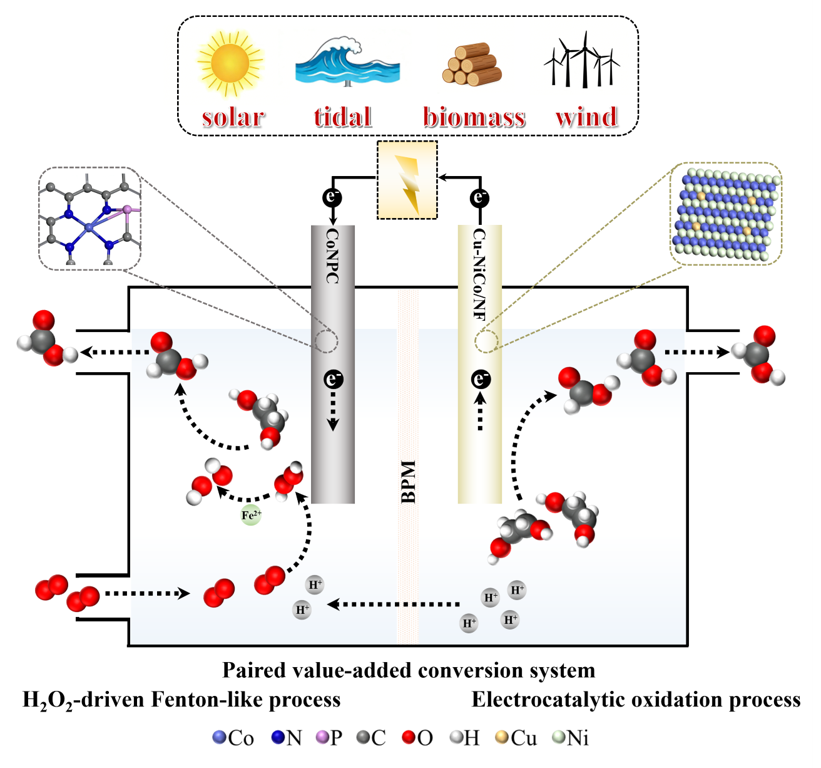
The high-efficiency electrosynthesis of hydrogen peroxide (H2O2) via two-electron oxygen reduction reaction (2e⁻ ORR) represents a promising alternative to traditional anthraquinone process. However, achieving high selectivity, industrial-grade stability, and on-site utilization of H2O2 remains a significant challenge. Here, we designed a single-atom catalyst CoNPC, featuring a Co–N/P co-coordination structure, tailored for high-current-density H2O2 electrosynthesis and relevant paired valorization of ethylene glycol. The P modulation optimized the electronic structure of Co centers, leading to enhanced selectivity (>90%) and stable H2O2 production for over 140 h at high current density of -200 mA cm−2. In-situ spectroscopic studies and theoretical calculations revealed that the P heteroatom plays a critical role in optimizing *OOH binding energy, thereby facilitating the 2e⁻ ORR process. The electrogenerated H2O2 was further utilized in a Fenton-like process to oxidize ethylene glycol to formic acid. By coupling this cathodic reaction with anodic EG electrooxidation, we demonstrated a paired electrolysis system that enables simultaneous value-added products at both sides. This work not only offers a robust strategy for the design of single-atom catalysts on industrial H2O2 electrosynthesis but also pioneers an energy-efficient paired electrolysis system for waste utilization.


