J.X. Ma, S.-Y. Lee * and Z.-S. Wu *
National Science Review, 2025, 12.
DOI: 10.1093/nsr/nwaf467 [PDF]
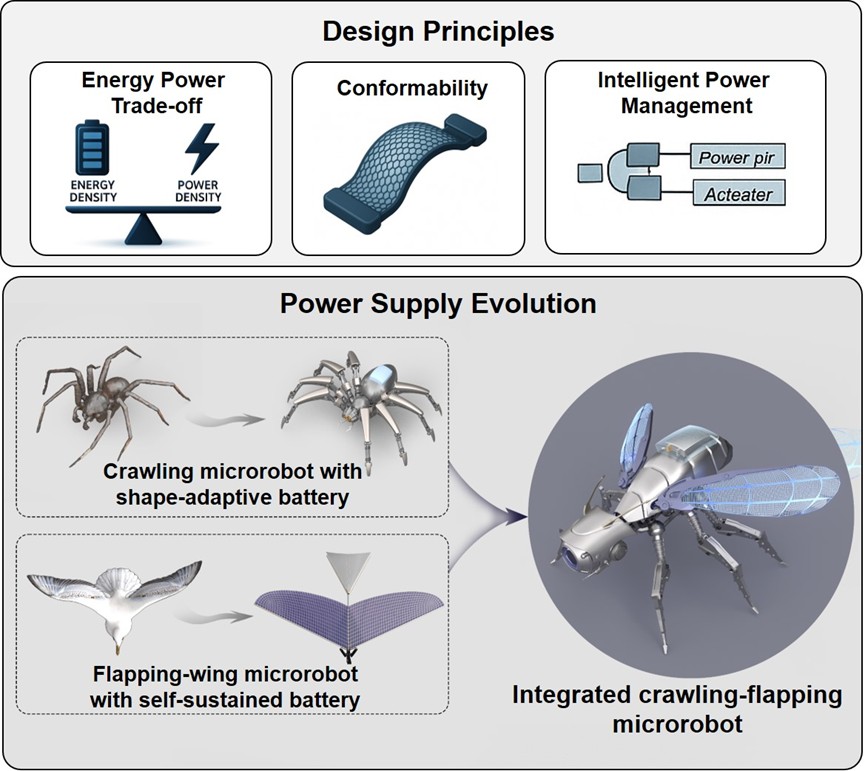
Taken together, advances in intelligent energy harvesting, wireless transmission, and AI-based power control are redefining structural microbatteries as mission-adaptive platforms, unlocking fully autonomous microrobot operation in extreme environments. Future integrated microsystems must seamlessly converge energy storage, mechanical function, and intelligent control, representing a fundamental shift from discrete power units to multifunctional, self-adaptive subsystems. This convergence bridges materials science, systems engineering, and artificial intelligence, empowering microrobots with unprecedented levels of autonomy, adaptability, and mission resilience. As these structural microsystems mature, they are poised to drive breakthroughs in implantable medical technologies, distributed sensing networks, and long-range autonomous exploration, fully aligning with global priorities in smart manufacturing, space technology, and biomedical innovation.


