Chen Zheng , Dong Li , Xiao Wang*, Zhong-Shuai Wu*
Science Bulletin, 2026, accepted.
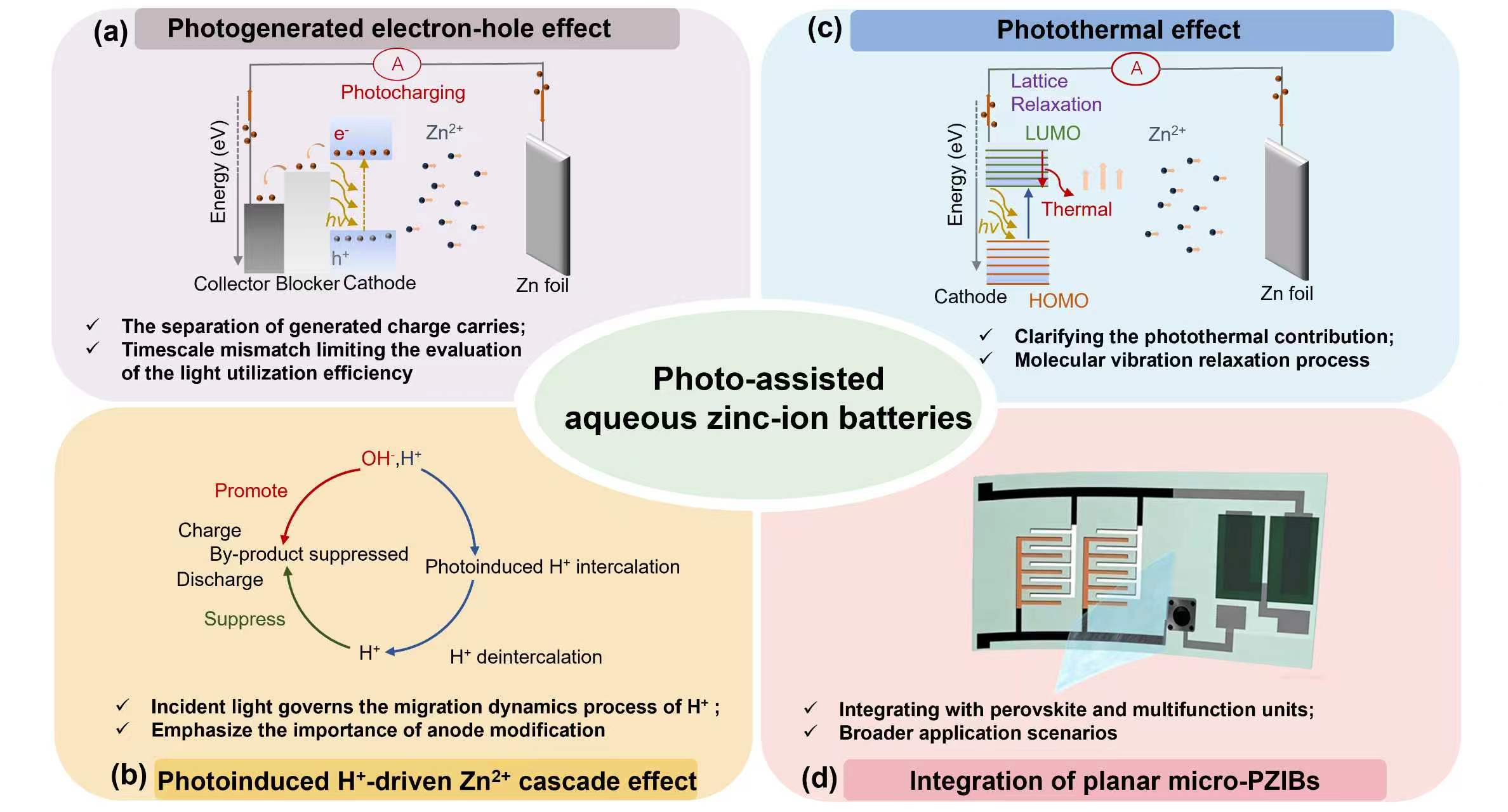
Aqueous zinc-ion batteries (ZIBs) are considered highly promising electrochemical energy storage systems owing to their inherent safety, high theoretical capacity (820 mAh g-1), and environmental compatibility. To further enhance their electrochemical performance, recent efforts have explored integrating light irradiation into ZIB operation, giving rise to photo-assisted aqueous zinc-ion batteries (PZIBs). These systems hold considerable potential for diverse applications, including microgrids and the Internet of Things (IoT). However, PZIBs should not be regarded simply as light-enhanced ZIBs. Their electrochemical performance is governed by three interrelated processes under irradiation: photoelectric conversion, photothermal conversion, and inherent redox reactions. A deep understanding of how photoelectric conversion regulates redox reactions at the microscopic electrode–electrolyte interface is required. At the same time, it is essential to decouple the photoelectric and photothermal effects and to design photoelectrode materials that fully harness the photothermal contribution. Even with optimized photoelectrode materials, practical PZIB performance remains constrained by device integration and microfabrication techniques. This perspective provides critical insights and strategic directions for understanding PZIBs as light-regulated interfacial electrochemical systems, in which carrier dynamics, ion transport, thermal effects, and device architecture collectively determine electrochemical behavior.


