Yiyuan Zhang, Xu Fu, Xianhong Wu*, Qiang Wang, Pratteek Das, Hanyang Chen, Run-Cang Sun*, and Zhong-Shuai Wu*
Applied Catalysis B: Environment and Energy, 2026, accepted.
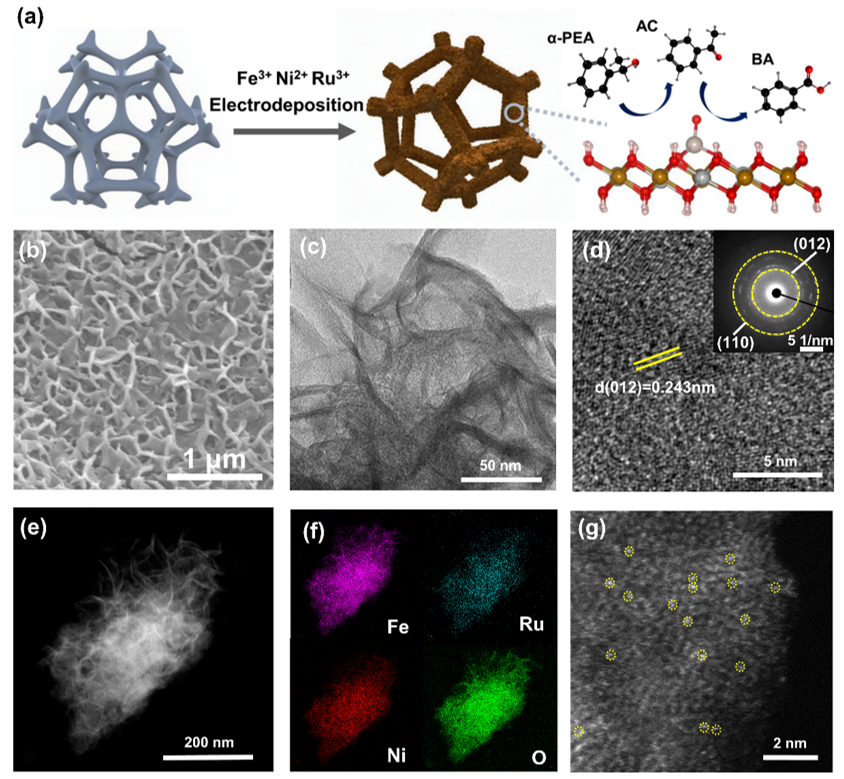
Electrocatalytic C(O)-C cleavage represents a pivotal pathway for the mild and efficient conversion of biomass, such as lignin, into high-value chemicals, but challenged by the high dissociation energy of C(O)-C bonds. Herein, we employ electrooxidation reaction of 1-phenylethanol (α-PEA) using single-atom Ru catalyst supported on NiFe layered double hydroxide (Ru/NiFe-LDH) as a probe reaction to elucidate the C(O)-C bond cleavage mechanism. The reaction proceeds through the concerted operation of two oxidation pathways: an “electrochemical-chemical” mechanism, in which electro-generated NiOOH oxidizes the alcohol to acetophenone, and an “adsorbed-OH-mediated mechanism”, in which surface OH species further oxidize the ketone intermediate to enable C(O)-C scission. Ru sites strengthen adsorption of the organic reactant and intermediate, while electronically tuned adjacent Ni sites favor OH adsorption. This dual-site electrocatalytic C(O)-C bond cleavage resulted in an α-PEA conversion rate of nearly 100% and a benzoic acid (BA) yield of 93.25%, substantially outperforming pristine NiFe-LDH. Given the structural similarity between α-PEA and the C(O)-C linkages in lignin, we further demonstrate successful cleavage of such bonds in lignosulfonate. Finally, we construct flow electrolyzer integrating α-PEA electrooxidation with the hydrogen evolution reaction, which can achieve the co-production of BA and hydrogen with low energy consumption. This dual-mechanism and dual-site electrocatalytic strategy offers a new paradigm for lignin valorization.


