Lisha Wu, Yuejiao Li, Zhong-Shuai Wu*
Advanced Energy Materials, 2026, accepted.
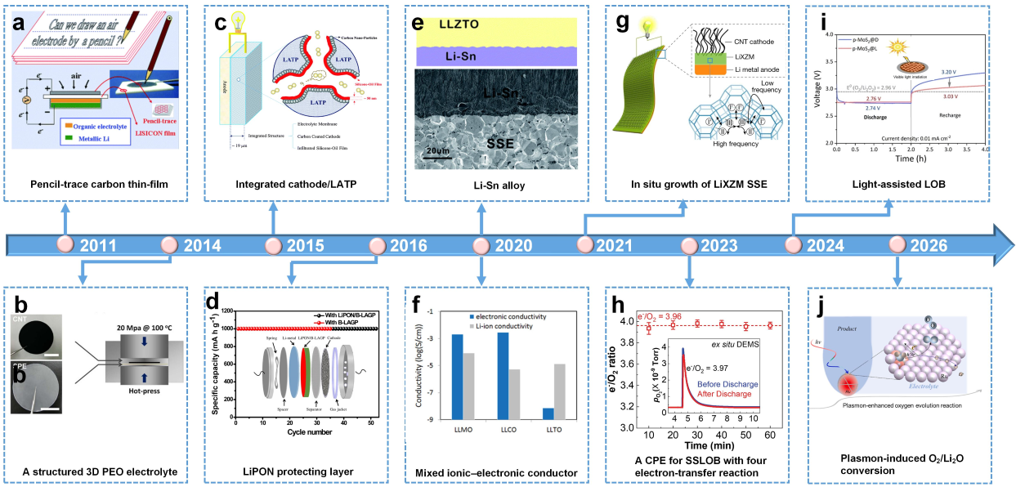
Solid-state lithium-oxygen batteries (SSLOBs) have garnered significant attention owing to their enhanced safety and exceptional theoretical energy density up to 3500 Wh kg−1. Nevertheless, inadequate interfacial contact and poor compatibility between electrodes and solid-state electrolytes (SSEs) remain critical barriers to achieving high-performance SSLOBs. To bridge this gap, this review systematically outlines the key challenges and recent advances in interfacial regulation and performance enhancement of SSLOBs. First, we introduce the fundamental principles and classifications of prevalent SSEs, followed by a discussion of the major challenges facing SSLOB development. Subsequently, we focus on interface engineering strategies aimed at improving battery performance, including the design of highly active cathode catalysts, the incorporation of polymer-based SSEs, and the construction of integrated cathode|SSE architectures for the cathodic interface. Simultaneously, the anodic interfaces can be stabilized by the application of functional polymer electrolytes, interfacial interlayer modifications, and the exploration of alloy anodes. Finally, we offer perspectives on the future design directions and the practical implementation of next-generation SSLOBs.


