Mingzhe Yang, Gongrui Wang*, Yuning Han, Yunyun Xu, Junpeng Sun, Yuxin Ma, Hai Yang, Li Song, Wenhao Cui, Ying Zhang, Juncai Sun, Yan Yu*, Zhong-Shuai Wu*
National Science Review, 2026, accepted.
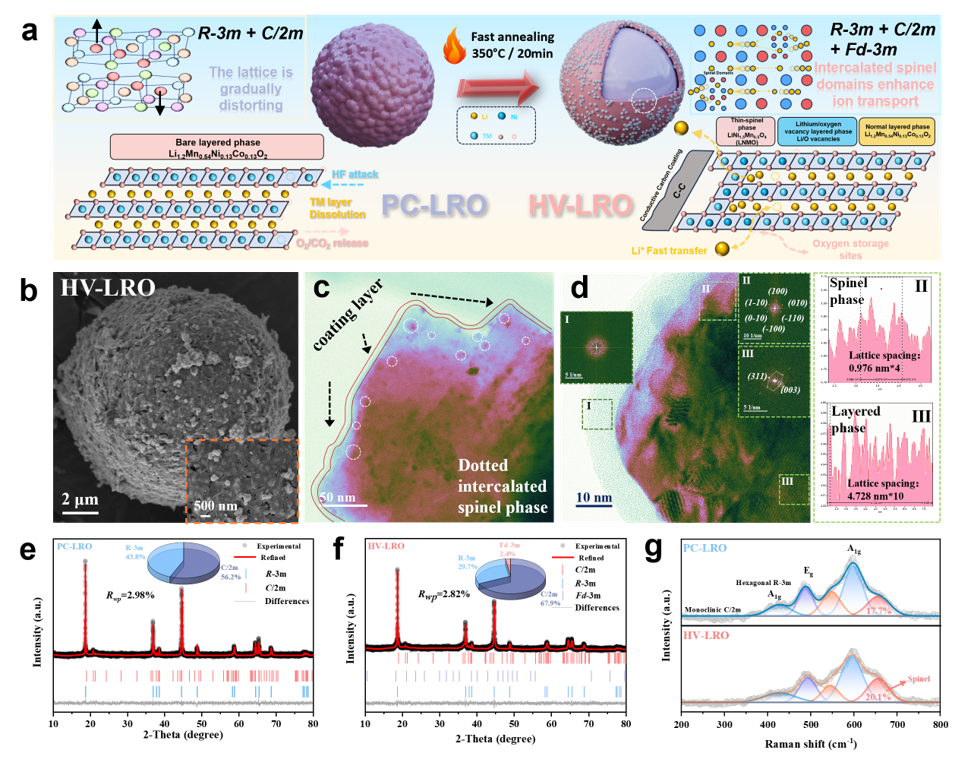
Lithium-rich manganese-based layered oxides (LROs) offer high theoretical capacity but are limited by irreversible oxygen redox, voltage fade, and structural degradation upon cycling. Herein, we develop a dual-interface engineering strategy for LRO cathodes, integrating a catalytic-shielded carbon coating and interface-confined discrete spinel domains. The carbon layer decouples electrolyte decomposition from lattice-driven catalysis, suppressing cathode-electrolyte interphase growth and oxygen release, while subsurface-confined spinel phases establish three-dimensional Li+ transport pathways and mitigate lattice strain. Ex-situ hard/soft X-ray absorption spectroscopy confirms enhanced anionic redox reversibility and stable charge compensation. Consequently, the optimized LRO achieves an initial Coulombic efficiency (ICE) of 93.1% with a discharge capacity of 295 mAh g-1 at 0.1 C, compared with 267 mAh g-1 and 79.0% for the pristine counterpart. It maintains 88.9% capacity after 150 cycles at 4.99 V (vs. 29.4% for pristine after 80 cycles) and 79.2% after 200 cycles at 45 °C. Remarkably, a 1.58 Ah Si/C||HV-LRO pouch cell delivers 307 Wh kg-1 energy density and retains 70.7% capacity after 100 cycles at 0.8 C, demonstrating practical viability for high-energy applications. This work establishes a paradigm for stabilizing high-voltage LRO cathodes through spatially decoupled interfacial catalysis and reinforcement.


