Yunyun Xu†, Dashuai Wang†, Yuejiao Li, Haifeng Qi, Zhuobin Guo, Tasmia Azam, Pratteek Das, Zhong-Shuai Wu*, and Hui-Ming Cheng*
Nature Communications, 2026, accepted.
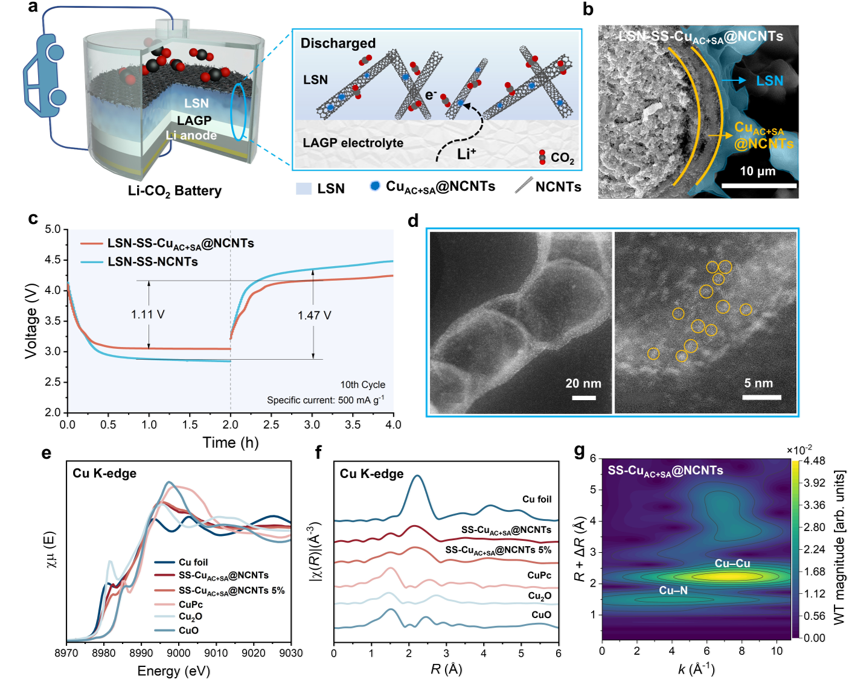
All-solid-state Li–CO2 batteries are limited by sluggish interfacial CO2 redox kinetics and the incomplete decomposition of insulating Li2CO3 at rigid solid-solid-gas interfaces. Here, we report an integrated cathode-electrolyte architecture in which copper atomic clusters and single atoms are co-anchored on freestanding N-doped carbon nanotubes and coupled with a succinonitrile/Li1+xAlyGe2-y(PO4)3-based solid-state electrolyte. The conformal ion-conducting phase and conductive nanotube scaffold provide coupled pathways for Li+, electrons and CO2 at the cathode interface. Electronic coupling between the copper atomic clusters and single atoms induces charge transfer from the former to the latter (~0.457 e−), rendering the Cu cluster sites partially cationic and facilitating the activation of carbonate intermediates. This dual-site configuration changes the discharge pathway and lowers the reaction energy of the rate-determining step to 2.412 eV. The assembled battery delivers a discharge capacity of 21356 mAh g−1 at 200 mA g−1 and operates for 260 cycles (>1000 h) at 500 mA g−1 with an energy efficiency of 78%. This work provides an interfacial design strategy for solid-state Li–CO2 batteries by coupling continuous transport pathways with electronically regulated dual Cu active sites.


