Huibing Lu, Gongrui Wang*, Zhong-Shuai Wu*
Science Bulletin, 2026, accepted.
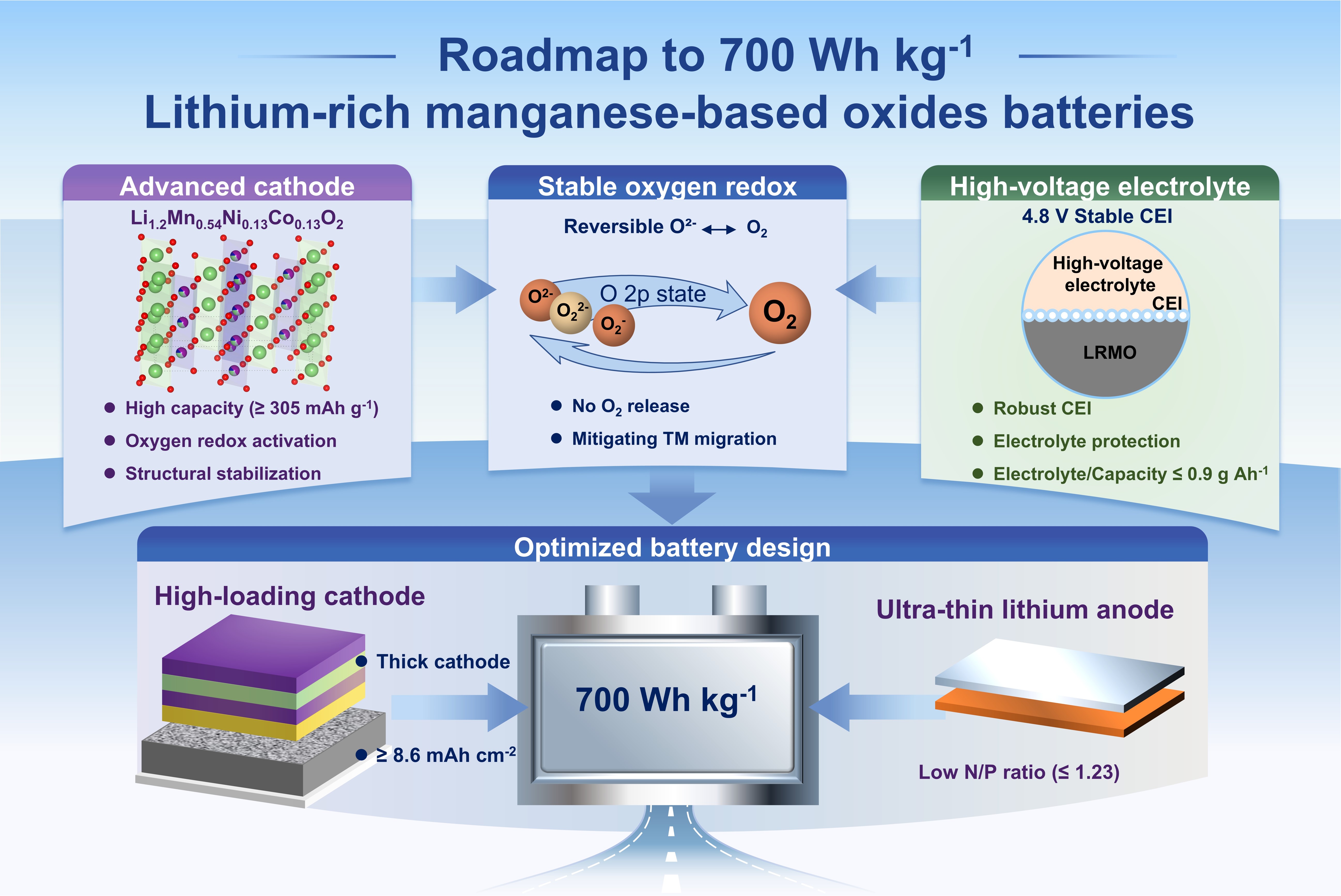
Driven by the goal of carbon neutrality, developing advanced lithium-ion battery systems with high energy density and sustainability has become a key direction in energy storage. Lithium-rich manganese-based oxides (LRMO) are considered promising cathode materials owing to their high specific capacity and high average discharge voltage, enabling ultra-high-energy-density batteries of 700 Wh kg-1. However, their practical application is still limited by irreversible oxygen redox reactions, structural degradation, voltage decay, and insufficient interfacial stability. This perspective discusses the key challenges to achieving ultra-high-energy-density batteries based on LRMO systems, focusing on cathode material design, lithium-metal anodes, high-voltage electrolytes, and device-level integration strategies. Achieving an energy density of 700 Wh kg-1 relies not only on high-capacity cathode materials but also on stabilizing lattice-oxygen redox reactions, optimizing electrode structures, constructing stable cathode-electrolyte interphases (CEI), reducing inactive components, and enabling synergistic design of cathodes, anodes, and electrolytes, as well as device-level integration. Future development of LRMO-based batteries requires comprehensive optimization of materials, interfaces, and system engineering to achieve a balance among high capacity, long cycle life, and high safety.


