Xiao Han, Jiaxin Ma*, Zhijun Yang, Caixia Meng, Feixiang Ding, Chunhua Ge*, Zhong-Shuai Wu*
Energy & Environmental Science, 2026, accepted.
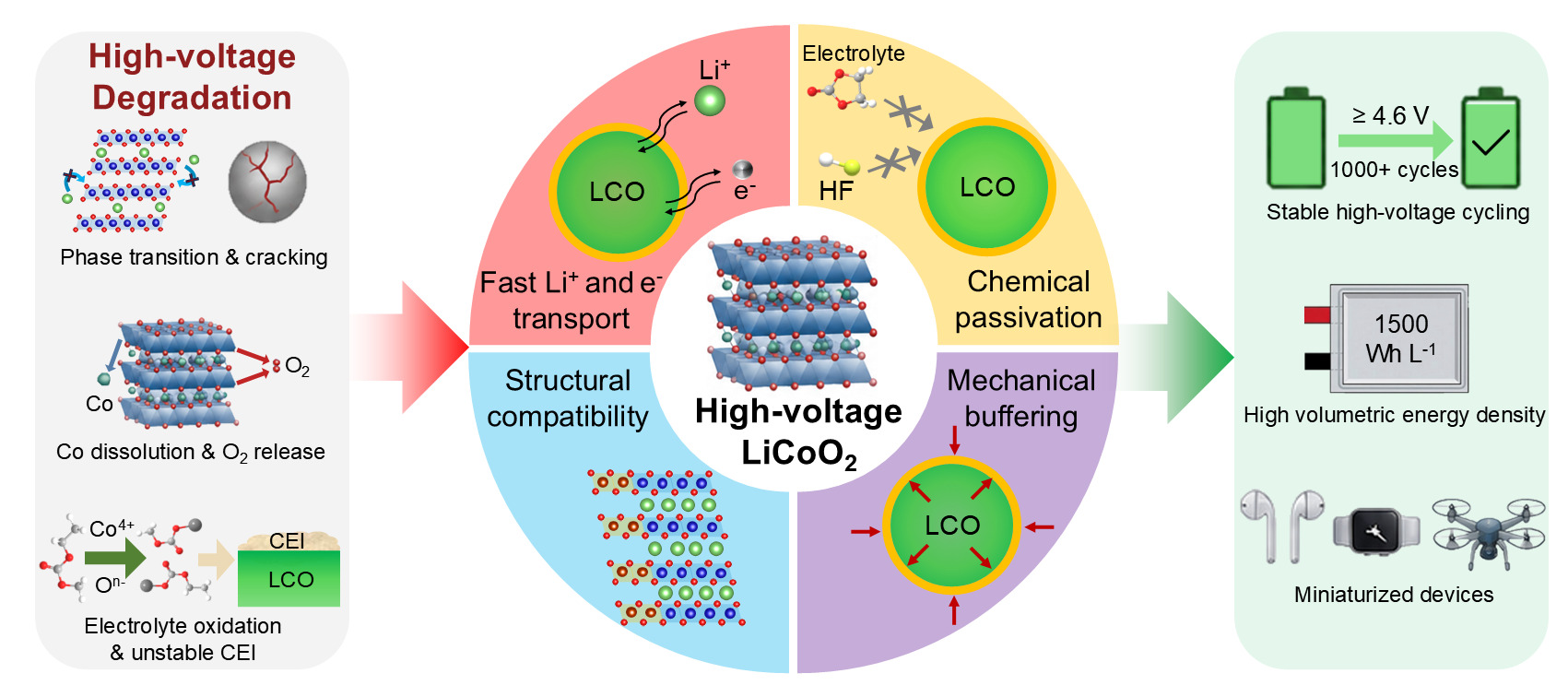
High-voltage operation beyond 4.5 V can fully unlock the capacity of layered lithium cobalt oxide (LCO), but it will simultaneously trigger coupled interfacial, structural and chemo-mechanical degradation, thus severely destroying the cycling stability. Various interface-engineering strategies have been developed to enhance high-voltage cycling performance of LCO, but they are typically categorized by material composition or manufacturing methods instead of interfacial functions, which obscures the understanding of underlying functions that govern their efficacy and the formulation of general design principles. In this review, guided by degradation mechanisms, we propose a function-based interface design framework that explicitly connects the coupled degradation pathways of high-voltage LCO with the multifunctional roles of engineered interfaces. Representative interface-engineering strategies are systematically categorized according to their interfacial functions, including accelerating Li+ transport, enhancing chemical stability, improving structural stability, and alleviating mechanical damage. This function-based framework elucidates the common design principles shared by diverse interface modification strategies, and provides a unified perspective for evaluating their effectiveness. Finally, we outline future research directions, including practical application-based performance evaluation and scalable production, intelligent and adaptive application, dynamic interphase regulation and advanced operando characterization, artificial intelligence and big data assisted simulation, and function-based interface design, thereby presenting a roadmap for the development of next-generation high-energy-density lithium-ion batteries.


