Caixia Meng, Chao Wang, Shiwen Li, Hanbing Liu, Yazhou Chen, Zibai Zeng, Jiaxin Ma, Qiang Fu, Zhong-Shuai Wu*
Journal of Energy Chemistry, 2026, accepted.
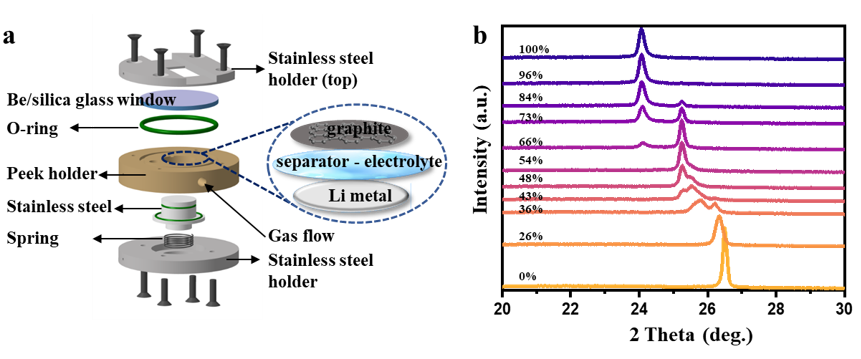
Calendar aging represents a fundamental challenge for the long-term performance of lithium-ion batteries, yet the role of ambient atmosphere particularly moisture in driving degradation mechanisms remains poorly understood. Herein, we employ atmosphere-controlled operando X-ray diffraction and Raman spectroscopy combined with porous low-loading graphite and ultrathin binder-free film electrodes to systematically investigate the open-circuit aging behavior of graphite anodes under controlled environments. Under inert conditions, we observe reversible lithium deintercalation from Li-graphite intercalation compounds, transforming stage-I LiC6 progressively into higher-stage structures and ultimately graphite, with full reversibility upon subsequent charging. In stark contrast, exposure to moisture-containing atmosphere triggers irreversible degradation. Depth-resolved X-ray photoelectron spectroscopy and time-of-flight secondary ion mass spectrometry reveal that H₂O induces severe reconstruction of the solid-electrolyte interphase, promoting LiPF6 hydrolysis, extensive LiF formation, and collapse of the organic-rich outer layer into a porous, inorganic-dominated structure. This defective interphase accelerates parasitic reactions, leading to rapid self-discharge, loss of lithium inventory, and complete irreversibility of lithium re-intercalation. Our findings establish moisture as a critical yet overlooked factor governing the calendar life of graphite-based lithium-ion batteries, and provide mechanistic guidelines for developing moisture-tolerant battery designs and advanced packaging strategies for applications.


