Yuan-Qi Sun , Bo Li , Xue Zhou , Sen Wang , Yang Liu , Xi Zhu , Tao Qin , Yu-Han Qu , Chang-Ze Li , Tong-Jian Liu , Xiao-Yue Wang , Peng-Peng Li , Yun Sun , Xin Yan , Xiao-Ming Li , Song Qiu , Chang Liu , Zhong-Shuai Wu , Yong Zhao , Tong-Lei Cheng , Dong-Ming Sun
National Science Review, 2026, accepted.
DOI: 10.1093/nsr/nwag550 [PDF]
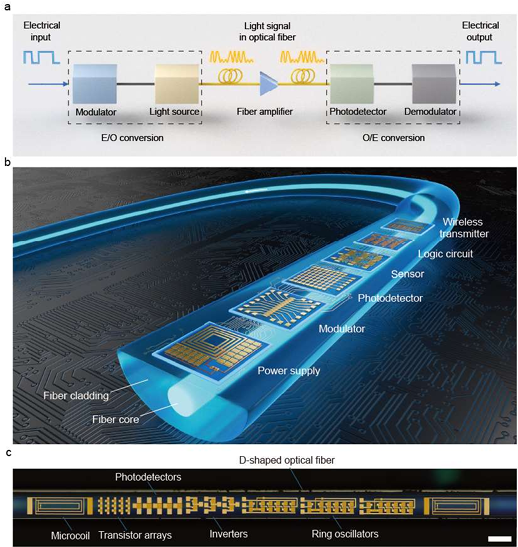
Optical fibers underpin the global information infrastructure, yet their role has remained largely passive—restricted to guiding light rather than processing it. Signal modulation, detection, and logic operations are still performed by external chips, imposing fundamental limits due to optical-electrical conversion losses, coupling complexity, and interconnection power overheads. Here, we propose an integrated fiber-electronics architecture that directly integrates active optoelectronic functionalities onto optical fibers. We demonstrate a multifunctional electronic-photonic system realized on the side-polished surface of a D-shaped optical fiber, incorporating carbon-based logic circuits, photodetectors, optically controlled inverters, and wireless-interface modules. This monolithic platform enables on-fiber logic operation, sensing, and interaction with the surrounding environment. The integrated devices exhibit outstanding performance: a digital inverter with a gain of 32, a five-stage ring oscillator operating at kilohertz frequencies, and a photodetector with a detectivity of 3.82 × 10¹⁶ Jones. Furthermore, optically controlled logic responses, temperature sensing, and sub-meter-scale wireless power and radio-frequency signal transmission are achieved. These results establish a proof-of-concept for active electronic and optoelectronic integration within optical fibers, representing a significant step beyond passive transmission media toward intelligent, distributed fiber networks capable of transmission, sensing, computation, and autonomous energy operation.


