Fangyan Liu, Jieqiong Qin, Chen Li*, Sen Wang, Zhuobin Guo, Junwei Sun, Xiaoyu Shi, Yuejiao Li, Zhong-Shuai Wu*
Nano Energy, 2026, accepted.
DOI: 10.1016/j.nanoen.2026.112356[PDF]
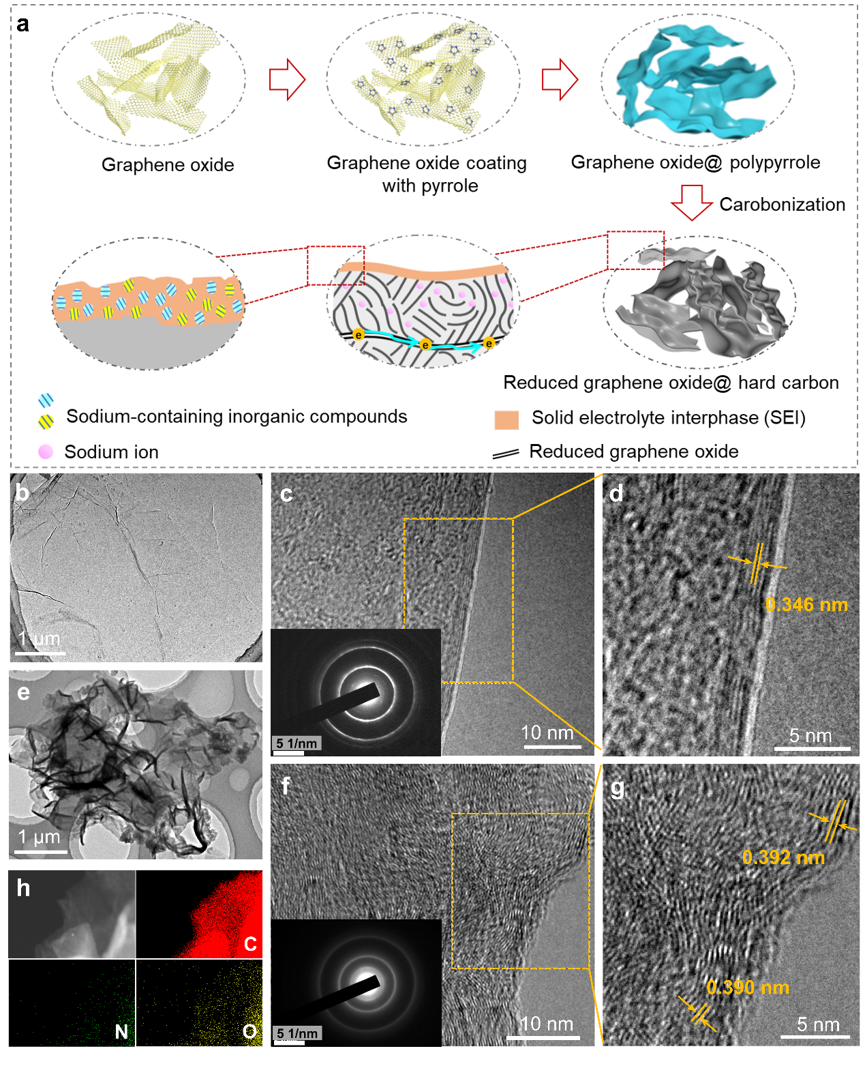
Carbon materials are pivotal for high-power sodium-ion batteries (SIBs). However, sluggish ion diffusion and interfacial instability impede the simultaneous achievement of fast-charging and long-cycling performance. Herein, we report a two-dimensional (2D) reduced graphene oxide@hard carbon (rGO@HC) heterostructure that enables rapid and durable sodium storage via synergistic structural and interfacial engineering. The heterostructure integrates the high conductivity of rGO, the expanded interlayer spacing of HC coating, and abundant mesoporous channels of rGO@HC to achieve fast Na⁺ storage and release. Meanwhile, the structurally robust rGO scaffold and crystalline HC surface bearing active sites synergistically ensures superior structural and interfacial stability. This unique structure realizes a surface-dominant pseudocapacitive adsorption-intercalation mechanism with a capacitive contribution up to 97.2%, and thus ultrafast sodium-ion reaction kinetics. Furthermore, a thin, inorganic-rich solid electrolyte interphase forms during cycling via progressive inorganic enrichment, effectively preserving interfacial stability over prolonged cycling. Consequently, rGO@HC anode delivers 102 mAh g−1 at an ultrahigh current density of 70 A g−1 and achieves 83.2% capacity retention after 70,000 cycles at 2 A g−1. This work offers a compelling strategy for designing robust carbon-based anodes that concurrently addresses the rate capability and cyclability challenges of durable high-power SIBs.


