Xingyu Yu†, Yunyun Xu†, Hao Gong, Zhixin Liu, Xingxu Gao, Kun Chang, Tao Wang*, Jianping He*, Zhong-Shuai Wu*
Angewandte Chemie International Edition, 2026, accepted.
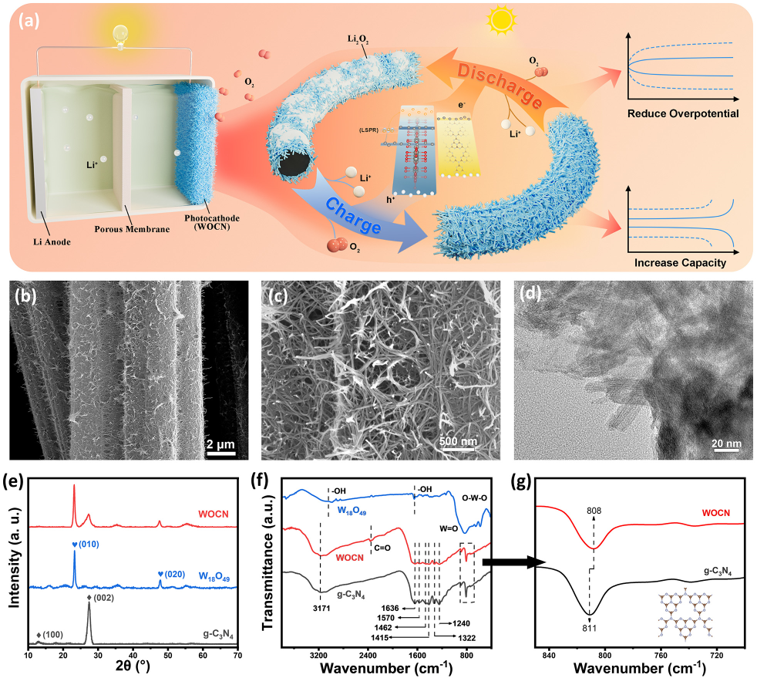
Li-O2 batteries (LOBs) offer an ultrahigh theoretical energy density but suffer from a large overpotential. Photocathodes can lower this overpotential, but most of them cannot achieve efficient charge separation, sufficient redox capability and broadband photoresponse at the same time. Here, a plasmonic S-scheme heterojunction photocathode (W18O49/g-C3N4, WOCN) is constructed. W18O49 serves as the oxidation semiconductor of the heterojunction and a noble-metal-free plasmonic absorber, forming a continuous plasmonic heterointerface with g-C3N4. The intrinsic localized surface plasmon resonance (LSPR) of W18O49 originates from periodically arranged lattice-localized electrons in W5+ clusters. Photogenerated carriers with strong redox capability and LSPR-generated hot electrons are separated by the S-scheme carrier transfer pathway. Under AM 1.5G illumination, the WOCN-based LOBs exhibit an ultralow overpotential of 0.04 V and a round-trip efficiency of 98.75%. Even under NIR illumination, an overpotential of 0.34 V and a round-trip efficiency of 90.12% are achieved, demonstrating an effective NIR response in photo-assisted LOBs for the first time. This work opens a new avenue for designing plasmonic S-scheme heterojunctions toward next-generation energy storage systems with full solar spectrum utilization.


