Tasmia Azam†, Pratteek Das†, Zhihao Ren†, Yuan Ma, Zhuobin Guo, Zhong-Shuai Wu*
Journal of the American Chemical Society, 2026, accepted.
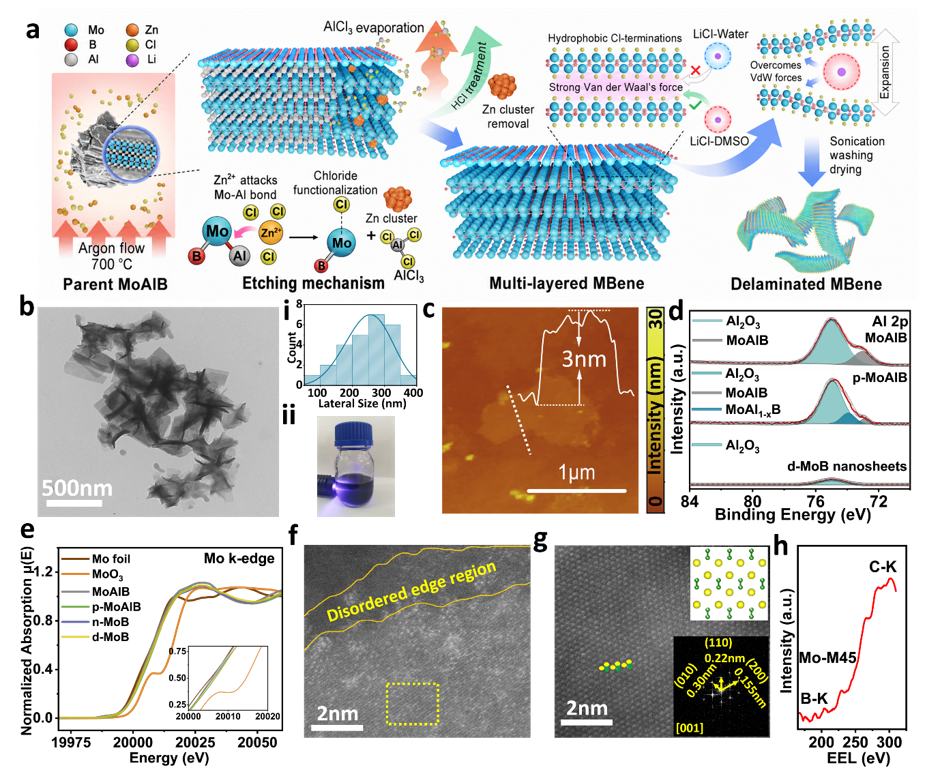
Delaminating MoAlB-etched MoB into high-quality well-separated boridene nanosheets remains a formidable challenge. Current methods yield thick, restacked assemblies, severely limiting its potential for high-performance applications. Herein, we report solvent-assisted delamination of MoAlB-etched MoB into two-dimensional (2D) boridene nanosheets by anhydrous Li-ion intercalation. The delaminated MoB (d-MoB) nanosheets show a uniform sheet-like morphology (~3 nm thickness, ~300 nm lateral size) and a high specific surface area. This strategy overcomes persistent challenges in reported methods, namely, incomplete Al deintercalation and poor delamination, by exploiting the fundamental mechanism of Li-ion intercalation in -Cl/O-terminated MoB. Specifically, Li-dimethyl sulfoxide (DMSO) complexes intercalate more efficiently due to low adsorption energy (Eads.≈ -3.934 eV) and enhanced electron localization, enabling effective solvent-driven delamination. The resulting d-MoB-based micro-supercapacitors deliver 102.4 mF cm-2 (10 mV s-1) in 1 M KOH, and achieve 4 µWh cm-2 at 350 µW cm-2. Moreover, they operate at -30 ºC and integrate with a d-MoB-based pressure sensor on a flexible platform, highlighting the importance of well-delaminated boridene nanosheets for flexible, integrated microsystems.


