Xiaosha Cui, Xiao Wang*, Zhong-Shuai Wu*
National Science Open, 2026, accepted.
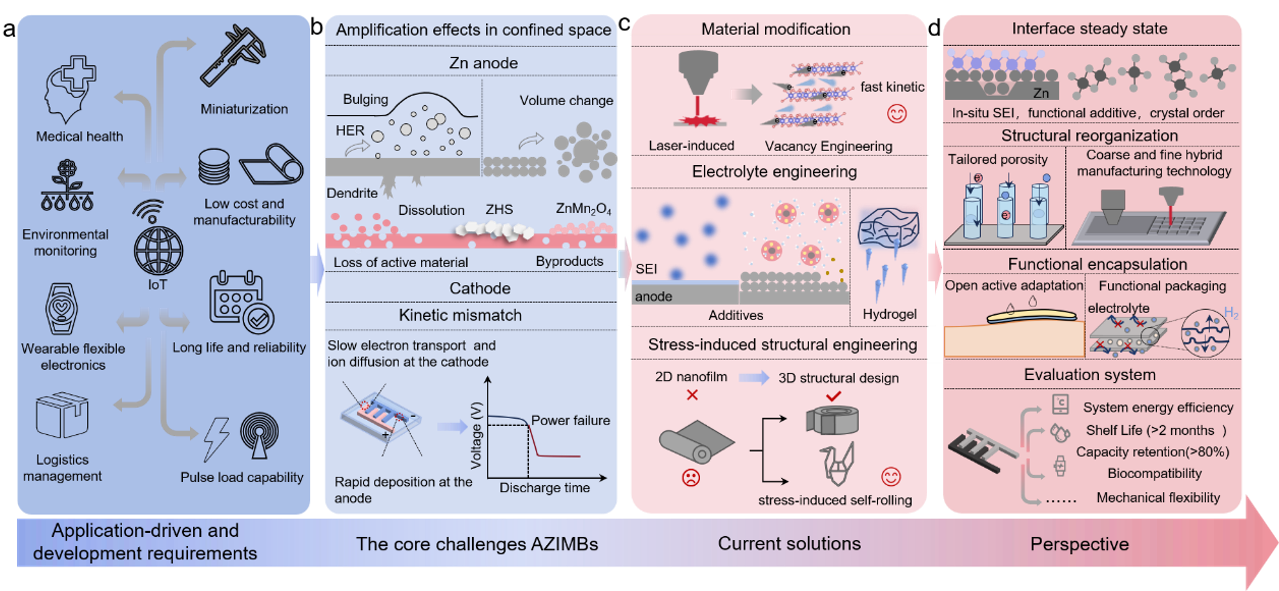
The rapid development of smart labels for the Internet of Things (IoT) and bioelectronics has intensified the demand for safe, flexible, and miniaturized power sources. Aqueous zinc-ion micro-batteries (AZIMBs) offer a promising alternative to lithium-based systems due to their inherent safety, low cost, and excellent biocompatibility. However, practical implementation remains fundamentally constrained by microscale scaling effects, including dendrite formation, hydrogen evolution, and kinetic mismatches. This perspective evaluates these core bottlenecks and summarizes recent breakthroughs in in-situ chemical modification and stress-induced structural engineering. To overcome the limitations of isolated component optimization, a comprehensive system-level co-design strategy is emphasized from thermodynamic and kinetic aspects. It is pointed out that well-designed zinc-based alloy anodes and kinetics-tailored cathodes with a pseudocapacitance-dominated mechanism could contribute to the stable micro-interface. Combined with a microelectrode featuring gradient 3D conductive networks via hybrid manufacturing, not only can kinetics be improved with multi-dimensional transport, but also internal stress can be dissipated. Furthermore, evaluation protocols that prioritize areal/volumetric performance, cyclability, and bio-mechanical compatibility should be taken into consideration when customized encapsulation ensures the stable output. This integrated framework provides a strategic route for the seamless monolithic integration of AZIMBs into next-generation intelligent systems.


