Xiaosha Cui, Xiao Wang*, Ho Seok Park*, Zhong-Shuai Wu*
National Science Review, 2026, accepted.
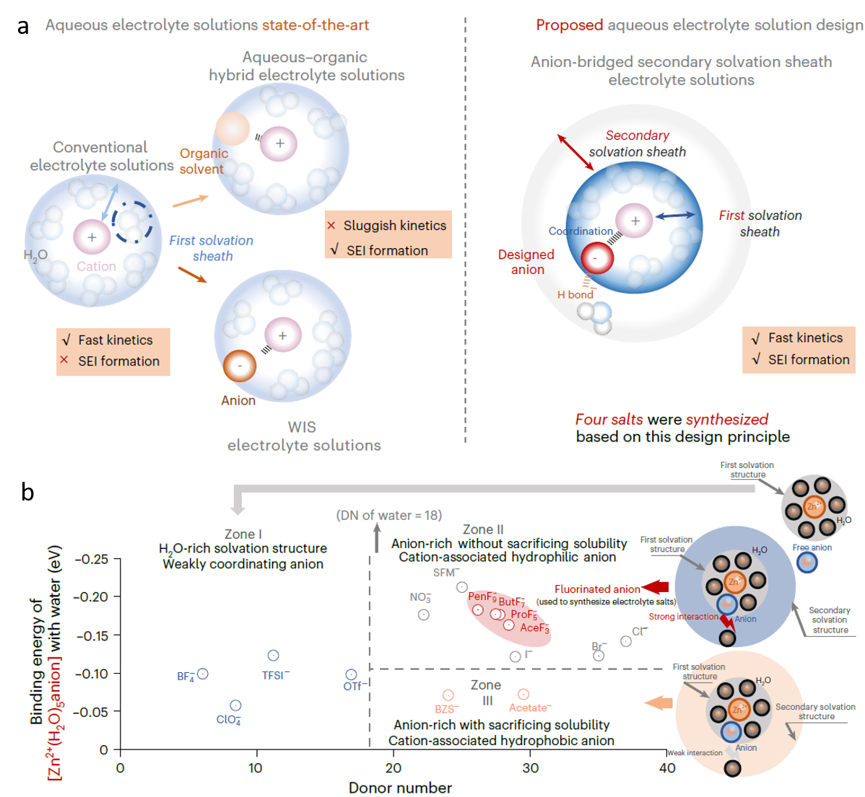
The scalable application of aqueous zinc-ion batteries remains constrained by severe parasitic side reactions and dendrite growth, both of which arise from the high reactivity of water. This research highlight explores a groundbreaking electrolyte design strategy for aqueous zinc metal batteries, moving beyond conventional primary solvation shell engineering. By leveraging the electron-accepting role of water, researchers introduced a mechanism where anions with a high donor number (DN>18) act as molecular bridges to anchor secondary-shell water molecules. This "anion-bridged" approach effectively immobilizes water, suppressing the hydrogen evolution reaction while enabling the in-situ formation of a protective, ZnF2-rich solid electrolyte interphase (SEI). Ultimately, this study provides a universal, data-driven descriptor for electrolyte optimization, successfully decoupling the long-standing trade-off between ionic conductivity and interfacial stability in aqueous multivalent battery systems.


