Yue Li, Yunyun Xu, Tasmia Azam, Tao Wang* and Zhong-Shuai Wu*
Advanced Materials, 2026, accepted.
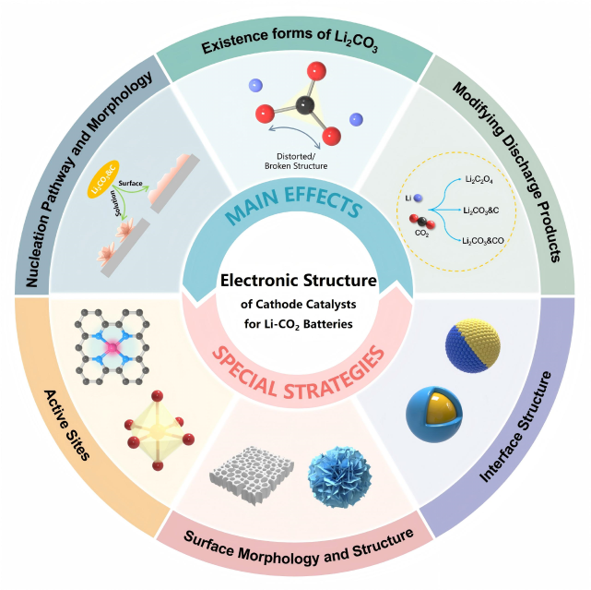
Lithium-carbon dioxide batteries (Li-CO2), featuring a high discharge voltage (~2.8 V) and a high theoretical energy density (1876 Wh kg–1), have garnered significant attention for their dual capability in energy storage and CO2 fixation. However, the complex reaction pathways across multiphase interfaces and sluggish discharge-charge kinetics result in poor reversibility, which severely hinders their practical application. Addressing these challenges necessitates the development of efficient cathode catalysts, whose activity is fundamentally governed by their electronic structure. In this review, we systematically elucidate the structure-performance-mechanism relationships of cathode catalysts in Li-CO2 batteries by first examining the underlying reaction mechanisms at the electrode-electrolyte interface. We then provide a detailed analysis of how the electronic structures of heterogeneous catalyst influence discharge-charge processes. Particular emphasis is placed on specific electronic structure modulation methods or their combinations, through strategies targeting active sites, surface morphology, and interface structure, as a pivotal route for constructing high-performance catalysts. Subsequently, we also discuss the underlying atomic-level origins of these modulation effects. Finally, we propose several future research directions aimed at advancing the fundamental understanding of Li-CO2 electrochemistry, optimizing electrocatalytic performance, and accelerating the practical implementation of Li-CO2 batteries.


