Xinglan Xiao, Haodong Shi*, and Zhong-Shuai Wu*
ACS Applied Materials & Interfaces, 2026, accepted.
DOI: 10.1021/acsami.6c08575[PDF]
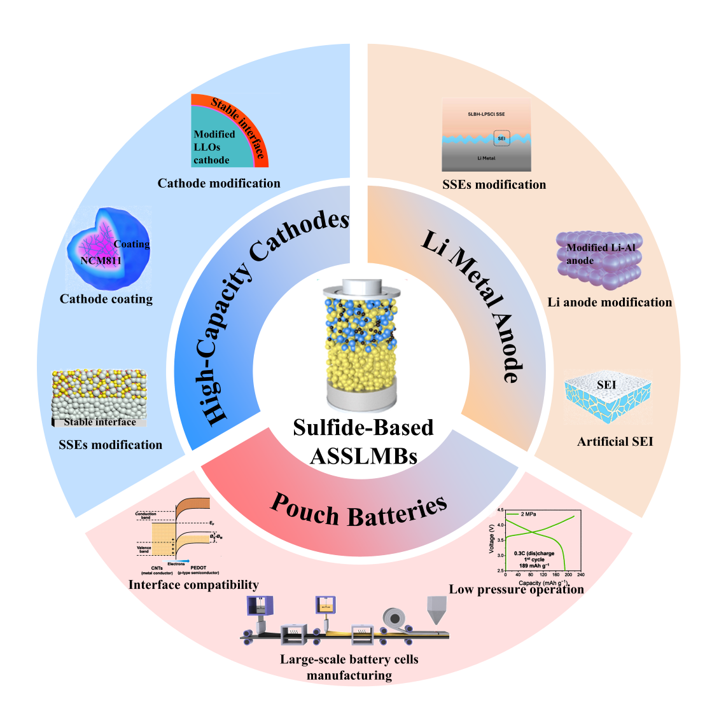
The demand for long-endurance power systems in energy vehicles, space shuttles, and drones require batteries with high energy density. Achieving this goal relies not only on advanced active materials but also on multi-scale collaborative design and precise manufacturing across the entire chain from material interfaces to electrode fabrication and cell integration. Sulfide-based all-solid-state lithium metal batteries have emerged as leading candidates for next-generation energy storage, owing to the high ionic conductivity of sulfide solid electrolytes, which is comparable to that of liquid electrolytes, and the high capacities enabled by high-capacity cathodes and lithium metal anodes. However, their practical development remains limited by interfacial instability, mechanical fragility, and processing challenges. This perspective first outlines the key obstacles to achieving energy densities exceeding 400 Wh/kg in sulfide-based all-solid-state lithium metal batteries, then focuses on corresponding solutions from three core aspects of high-capacity cathodes, lithium metal anodes, and practical pouch cells. Finally, perspectives on future theoretical research and practical industrialization directions are discussed. We aim to inspire the adoption of simple and low-cost design strategies to accelerate the commercialization of high-energy-density sulfide-based all-solid-state lithium metal batteries.


