Lisha Wu, Yuejiao Li, Yanfeng Dong, Yajun Ding, Caixia Meng, Feng Zhou, Haodong Shi, Zhong-Shuai Wu*
Angewandte Chemie International Edition, 2026, accepted.
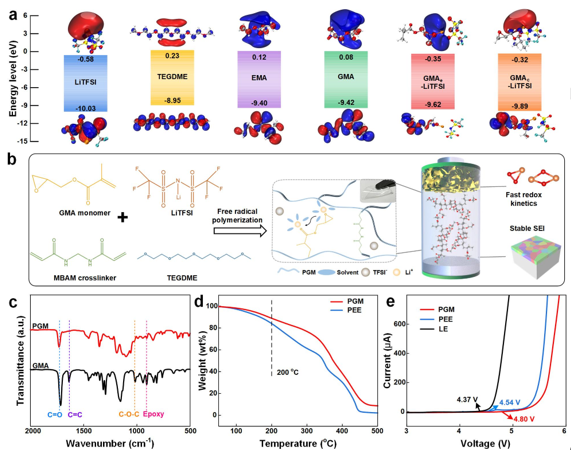
The vision of commercializing high-energy-density solid-state lithium-oxygen battery (SSLOBs) is hindered by poor interfacial compatibility and sluggish cathodic reaction kinetics resulting from the solid-solid contact on both sides of the solid electrolyte. Herein, an innovative polymerized glycidyl methacrylate (PGM) electrolyte with abundant active oxygenated groups (AOGs), i.e., C=O and C−O−C, is demonstrated to synchronize bilateral interfacial compatibility and accelerated cathodic reaction kinetics for high-performance SSLOBs. Notably, the PGM modulates the Li+ solvation structure by expelling partial solvent molecules, inducing the formation of dense oxide-rich solid electrolyte interphase on the Li metal anode, which suppresses dendrite growth. Theoretical calculations further elucidate that the AOGs stabilize the lithium-oxygen intermediates (e.g., LiO2, Li2O2) and lower the energy barrier for Li2O2 decomposition, thereby accelerating oxygen reaction kinetics. Consequently, the PGM-based LOBs (PGM-LOBs) exhibit a high capacity of 13076 mAh g−1 at 200 mA g−1, a low overpotential of 0.56 V, and a long life of 150 cycles (1500 h). In ambient air, PGM-LOBs maintain stable cycling for 400 h and deliver a discharge capacity of 19044 mAh g−1 at 200 mA g−1. This study demonstrates a feasible AOG-rich polymer electrolyte design strategy to simultaneously improve interfacial compatibility and oxygen redox kinetics for advanced SSLOBs.


