Z.J. Yang, J.X. Ma * and Z.-S. Wu *
National Science Review, 2026, accepted.
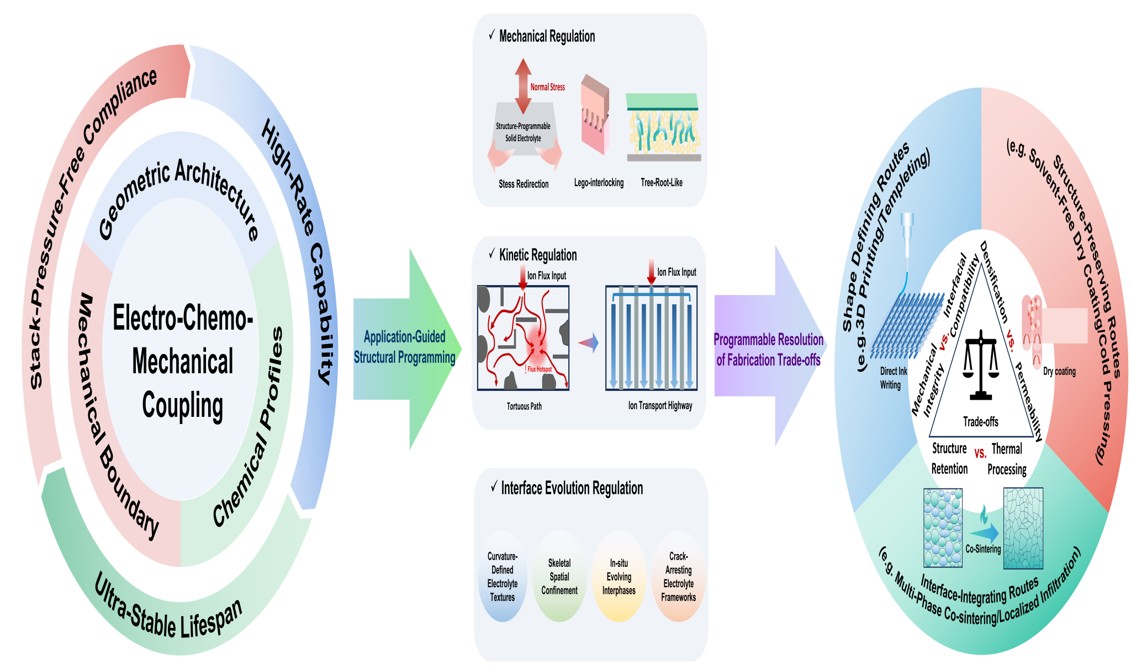
The paradigm of structure-programmable solid electrolytes represents a fundamental shift from passive material optimization to the active spatiotemporal management of complex electro-chemo-mechanical processes. When integrated with advanced fabrication methodologies, these principles enable electrolyte architectures that function not only as ionic conductors but also as structural frameworks governing device stability and performance. To propel this field beyond static structural regulation toward intelligent and adaptive electrolyte systems, the exploration of this expansive multiscale design space will increasingly rely on AI-assisted inverse design and digital twin frameworks. By coupling multiphysics simulations with generative models and Bayesian optimization, these tools can directly optimize explicit features (e.g., interlocking topologies, porosity gradients) and extract latent structural parameters, ultimately balancing theoretical performance limits with practical manufacturing feasibility. Together, these advances will pave the way for monolithic structural stack-pressure-free all-solid-state micro-batteries, transforming micropower sources from mere energy-storing functions into integrated and load-bearing components that fundamentally empower next-generation autonomous microsystems.


