H.F. Liu, F. Zhou *, M. Yang, X.X. Li and Z.-S. Wu *
Energy Storage Science and Technology, 2026, accepted.
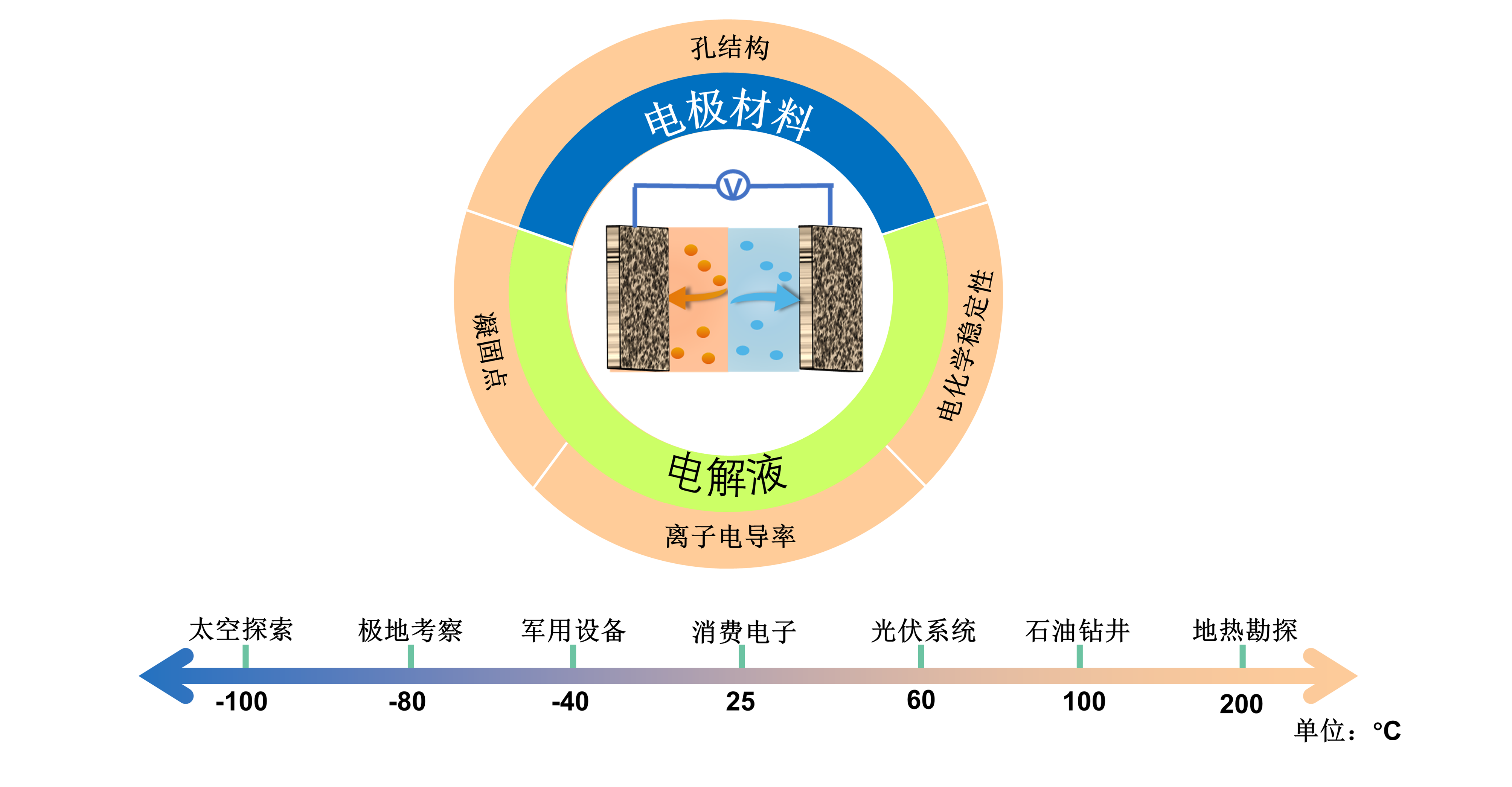
Electrochemical energy storage devices face numerous critical challenges in their widespread applications, particularly under low-temperature conditions, where issues such as electrochemical performance degradation and even device failure frequently occur. Compared with lithium-ion batteries, which store energy via Faradaic reactions, electric double-layer capacitors (EDLCs) exhibit unique potential for addressing low-temperature electrochemical energy storage challenges due to their physical adsorption-desorption mechanism. However, they still encounter numerous obstacles in practical applications. Under low-temperature conditions, the ionic conductivity of the electrolyte decreases and the electrolyte may even solidify, while ion diffusion within electrode materials becomes restricted, severely limiting the electrochemical performance of EDLCs. Therefore, designing electrolytes with excellent low-temperature performance, featuring both high ionic conductivity and an ultra-low freezing point, along with developing matching electrode materials, has become critical for advancing low-temperature EDLCs. This review first elaborates on the fundamental working principles of EDLCs and systematically analyzes the key challenges they face in low-temperature environments. Building on this foundation, it provides a discussion of the advantages and disadvantages of various electrolytes, including aqueous, organic, and ionic liquid electrolytes, as well as the design principles for electrolytes and electrode materials. Subsequently, recent research progress in the design of both electrolytes and electrode materials is reviewed. Finally, future research directions for low-temperature EDLCs are proposed, aiming to provide theoretical guidance and technical references for the development of next-generation high-performance low-temperature EDLCs.


