Z. Chen, L.Z. Zhang *, G.Q. Li, C.L. Wang, H. Lin, L. Wang, R.L. Guo, M.J. Liu, Z.B. Guo, P. Das, L.W. Li, J.M. Wang *, L. Wang ,Y.R. He, S. Feng, D.-M. Sun, T. Bo, P.C. Lian, Z.-S. Wu * and H.-M. Cheng *
Journal of the American Chemical Society, 2026, accepted.
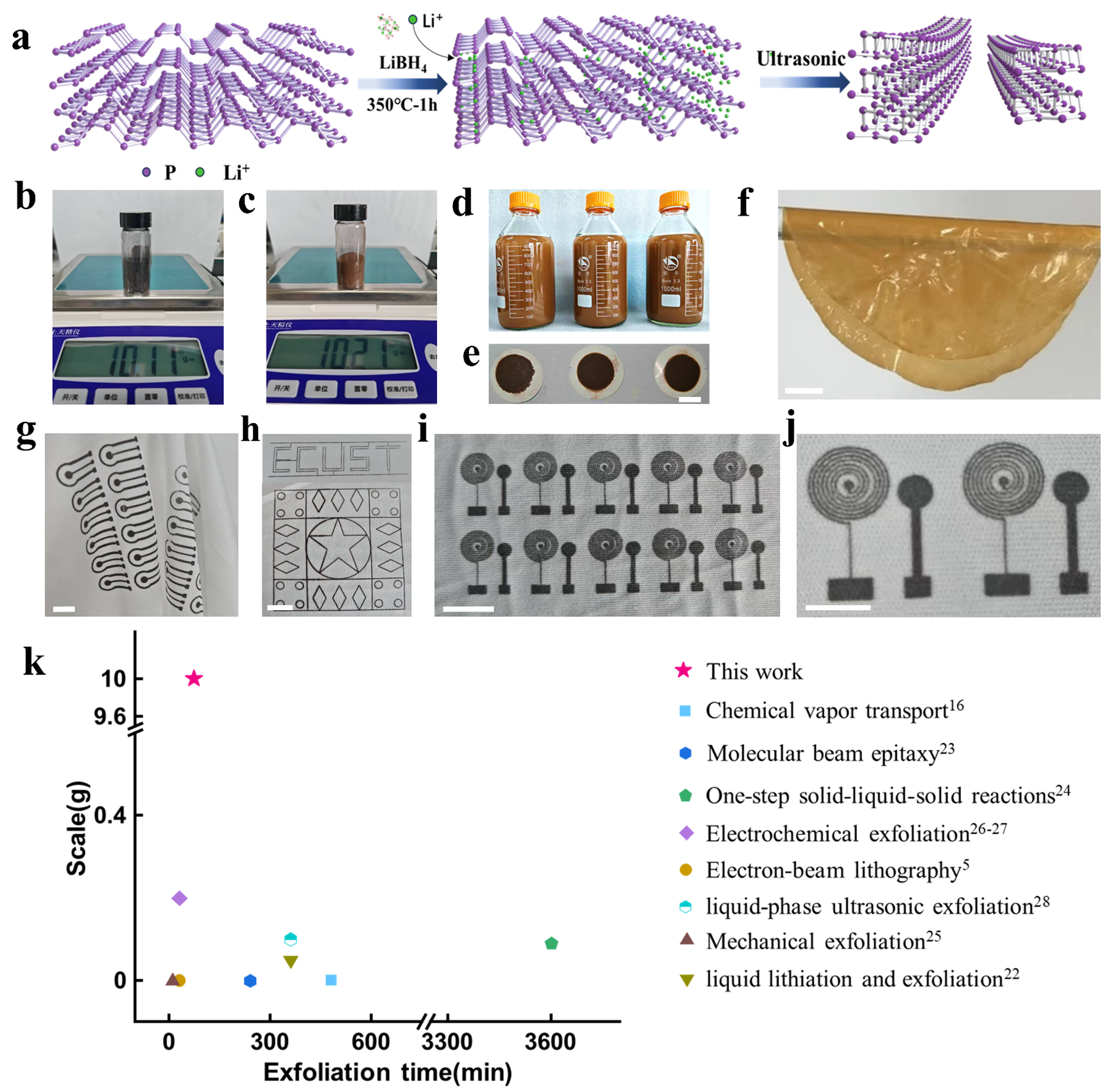
Black phosphorene nanoribbons (PNRs) are unique quasi-1D nanomaterials that have attracted enormous interest due to their properties, such as tunable bandgap, magnetism and semiconducting ground states at room temperature. However, the scalable synthesis of PNRs has remained a considerable challenge. We report the scalable topochemical synthesis of PNRs by the solid lithiation of black phosphorus (BP) powder and subsequent exfoliation into nanoribbons. The produced PNRs have an average length of 3.48 μm, an aspect ratio up to 137, a minimum thickness of 5 layers for individual nanoribbons, and an average thickness of 14 layers. This method has a high yield of 61%, a powder production scale of 10 g and a liter-range colloidal dispersion. The PNRs can be easily processed into versatile flexible devices on a fabric substrate by screen printing. A cellulose/(DMF-dispersed PNR) (Cel/D-PNR) flexible film has excellent flame-retardant properties, with a limiting oxygen index(LOI) reaching 33%. PNR-supported Co nanoparticles (Cox-PNR) had an outstanding oxygen evolution reaction (OER) performance with an overpotential of only 350 mV at 10 mA/cm2. The work allows the scalable production of PNRs in order to explore their potential applications in flexible electronics and energy conversion.


