J.X. Lyu, X. Wang *, J.Q. Qin, S.X. Wang * and Z.-S. Wu *
Batteries & Supercaps, 2026, accepted.
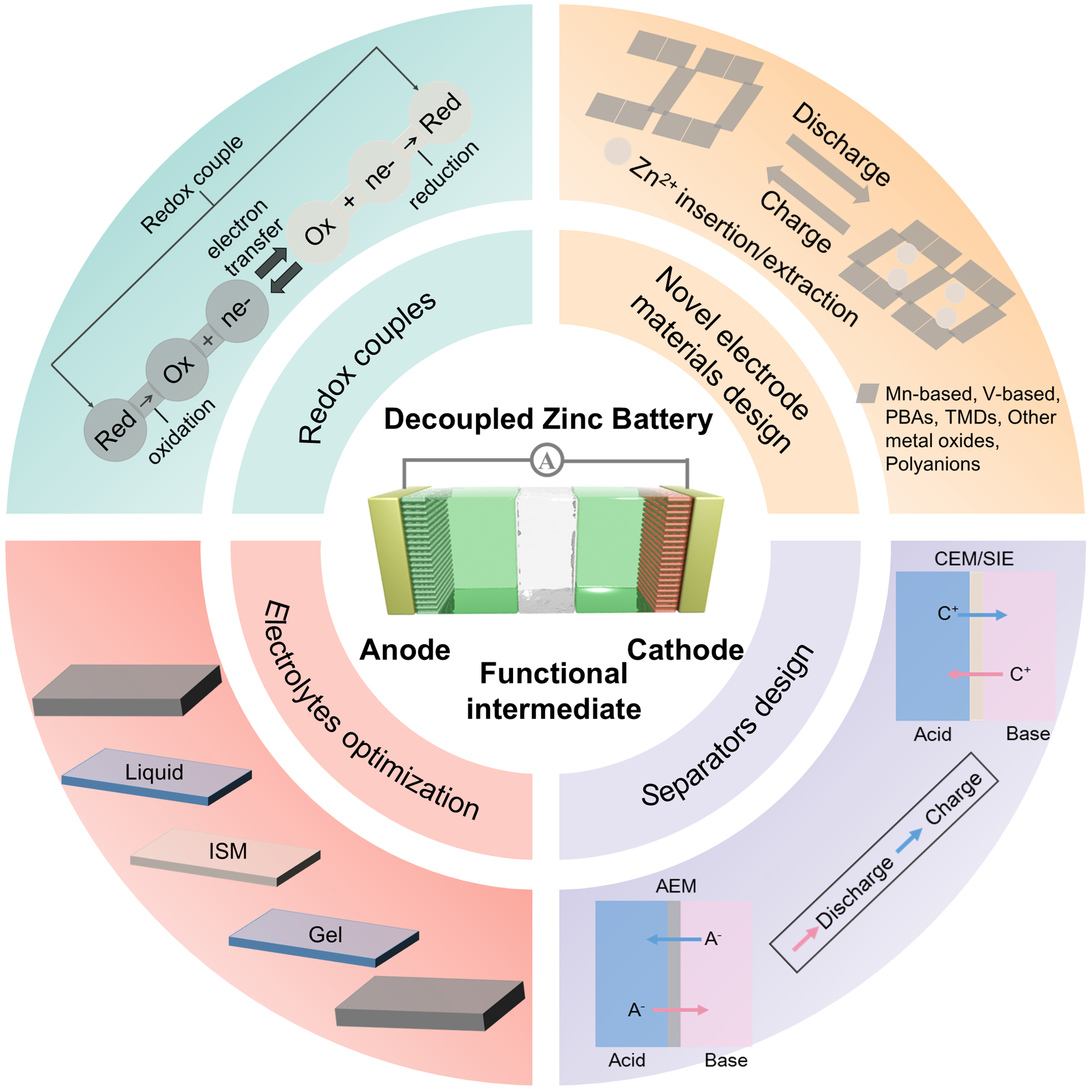
Aqueous zinc-based batteries suffer from a narrow electrochemical stability window and severe side reactions, limiting their practical applications. To address these challenges, decoupling the reduction and oxidation reactions during charging/discharging by physically or chemically isolating the anode from the cathode could effectively suppress water decomposition and increase the operating voltage. Herein, we systematically strengthen the key components of decoupled zinc-based batteries (DZBs) including the functional intermediates and redox couples. According to the different redox couples, diverse DZB prototypes are summarized including Zn-MnO2, Zn-S/Se, Zn-I2, Zn-Br2, Zn-CO2 batteries. Particularly, the key approaches for high performance DZBs are introduced, such as the decoration of ion-selective membranes to improve selectivity, composite redox mediators to accelerate reaction kinetics, atomic catalysts to enhance iodine conversion, and flow-battery architectures to improve reversibility. Subsequently, advanced strategies in electrode structure design, interface engineering, and electrolyte engineering are overviewed in different prototypes. Finally, critical scientific issues and promising development directions are proposed toward high-energy-density and durable DZBs.


