F.Y. Liu *, D.J. Yi, J.Q. Qin, W.T. Wang, H.L. Yuan, X.Y. Shi and Z.-S. Wu *
Chinese Chemical Letters, 2026, accepted.
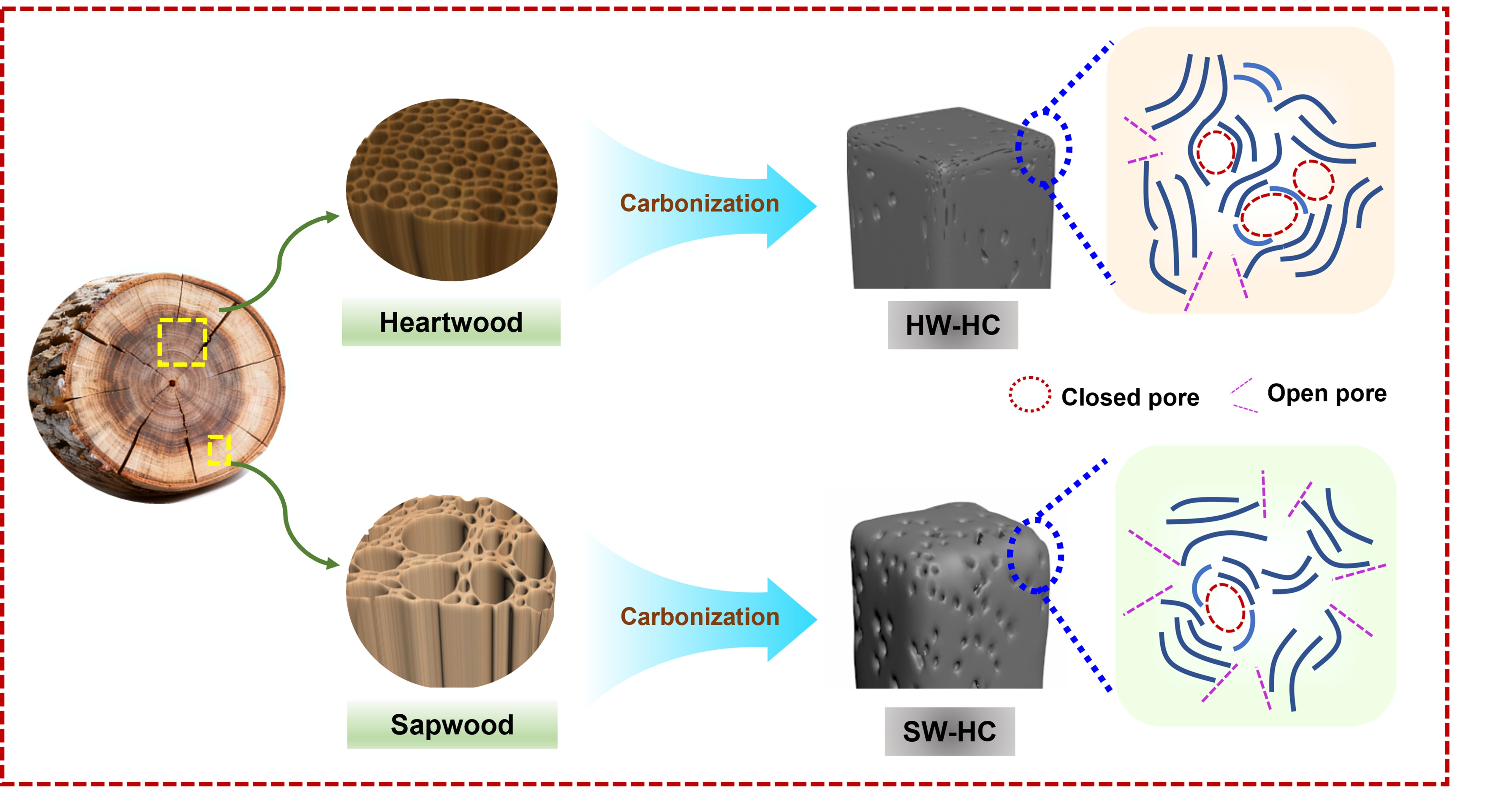
The growing demand for grid-scale energy storage has heightened research into sustainable hard carbon (HC) anodes derived from woody biomass for sodium-ion batteries (SIBs). Nonetheless, the impact of inherent wood heterogeneity on HC properties remains inadequately comprehended. This study reports the controllable preparation of high-performance HC anodes for sodium ion batteries. To this end, we conduct a systematic comparative investigation of HCs derived from heartwood (HW) and sapwood (SW), revealing that intrinsic biomass heterogeneity fundamentally governs their physicochemical properties and sodium-ion storage behavior. HW with the denser fiber matrix, elevated lignin content, and increased cellulose crystallinity yields HC (HW-HC) with a higher graphitization degree, more ultromicropores and larger closed-pore volume. In contrast, SW characterized by broader wood fibers and elevated cellulose/hemicellulose content produces HC (SW-HC) with enhanced open porosity. Consequently, HW-HC delivers higher reversible capacity (286 vs. 272 mAh g⁻¹ of SW-HC at 0.05 A g⁻¹) and plateau capacity at low rates, whereas SW-HC demonstrates better rate capability (124 vs. 93 mAh g⁻¹ of HW-HC at 2 A g⁻¹) and faster electrochemical kinetics. Both HCs follow an adsorption-intercalation-pore filling mechanism, with pore-filling initiating at a slightly higher potential in HW-HC. This study highlights the crucial influence of wood heterogeneity in dictating HC properties and offers a rational guideline for selecting biomass precursors to engineer high-performance anodes of SIBs.


