L.S. Wu, Y.J. Li, Y.J. Ding, Y.F. Dong, C.X. Meng, F. Zhou, G.R. Wang and Z.-S. Wu *
Advanced Energy Materials, 2026, accepted.
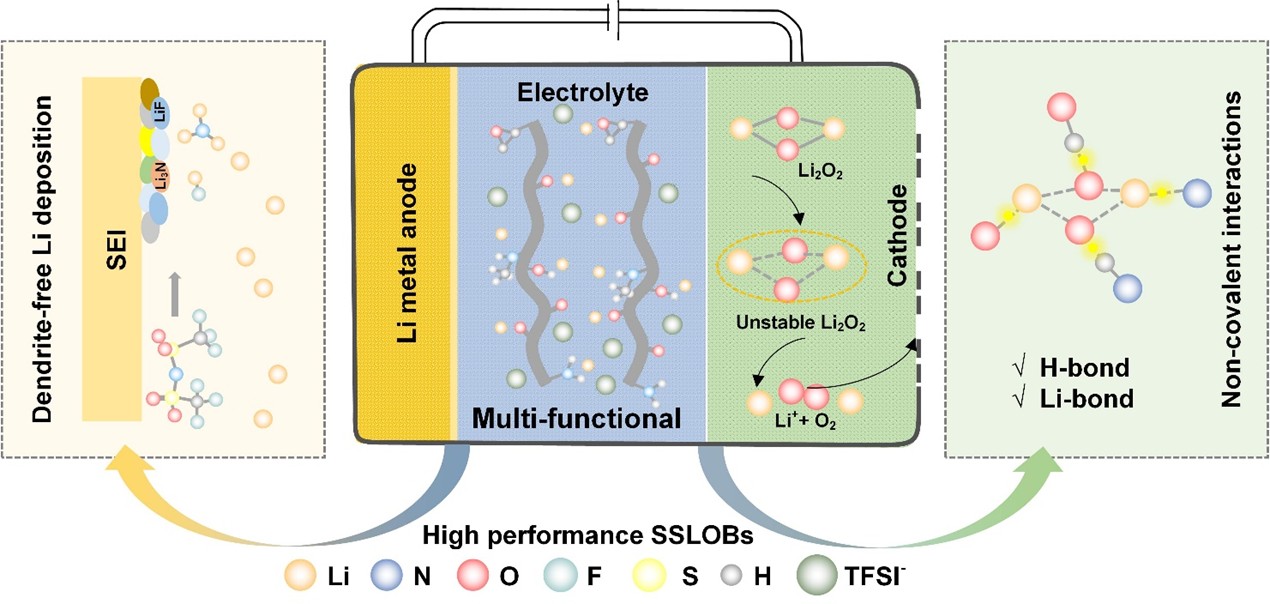
The persistent challenges of sluggish redox kinetics in lithium-oxygen batteries (LOBs) necessitate the exploration of active and compatible solid-state electrolytes (SSEs). Herein, we report a multi-functional gel polymer electrolyte (denoted as PGFEN) with well-defined functional groups through ring-opening reaction in the polymerized glycidyl methacrylate/2,2,3,4,4,4-hexafluorobutyl acrylate electrolyte (PGFE) induced by N-containing groups, to provide non-covalent interaction networks towards stable ultra-low overpotential solid-state LOBs. Concretely, the molecular-level micro-environment facilitates the dissociation of Li-TFSI and alters the solvation structure via Li/H bond, thus enabling an ionic conductivity of 0.22 mS cm−1. Moreover, the polar oxygen/nitrogen sites within multiple functional groups dynamically break the symmetry and stability of Li2O2 and accelerate the redox kinetics via non-covalent interactions, as evidenced by the theoretically elongated bond length and lowered Mayer bond order of Li−O bonds, thus reducing discharge/charge overpotential to 0.56 V for 100 cycles, and delivering an ultrahigh discharge capacity of 31718 mAh g−1 at 500 mA g−1. Importantly, the smooth operations of a pouch-type LOB for 70 cycles and a Li−air battery for 400 h demonstrate the great potential in practical application. This work opens new avenues using non-covalent interactions to create efficient and stable SSEs for advancing the rapid development of LOBs.


