Y. Liang †,*, Y. Lu †, J.H. Zhang †, Z.C. Xu †, M.Z. Xiu, J.Y. Xia, J.R. Yue, Y.F. Li, Y. Cui, Y.P Xie*, Y.Z. Huang*, G.W. Xu and Z.-S. Wu
Carbon Energy, 2026, accepted.
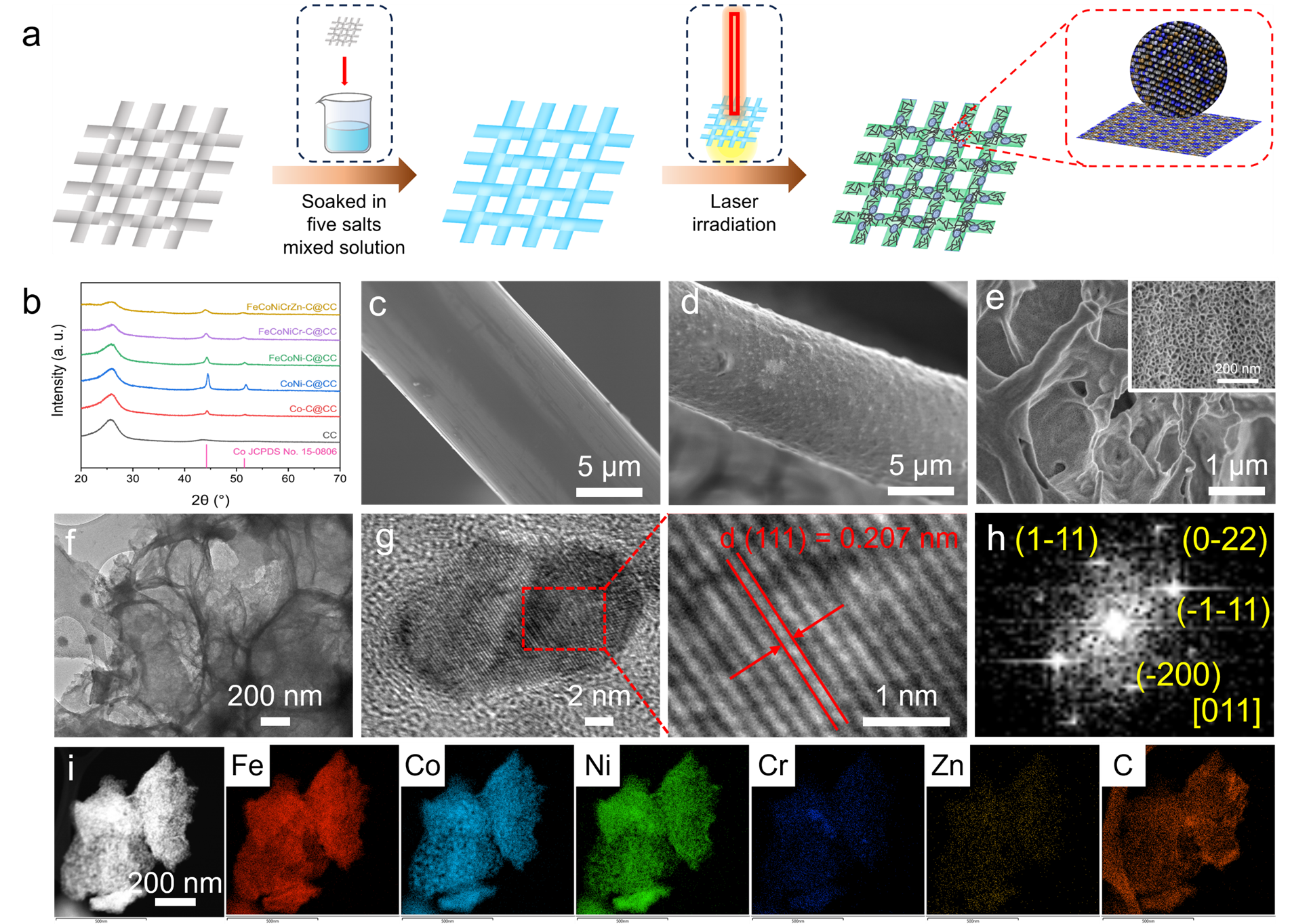
The large-scale implementation of electrocatalytic water splitting for green hydrogen production is hindered by the sluggish kinetics of the oxygen evolution reaction (OER), necessitating efficient and durable catalysts. Here, we report an innovative ultrafast synthesis strategy using pulsed laser irradiation for the one-step fabrication of a nanoporous carbon-coated FeCoNiCrZn high-entropy alloy (HEA) supported on carbon cloth (FeCoNiCrZn-C@CC), with L-ascorbic acid as an auxiliary agent. This resulting catalyst exhibits exceptional OER performance, achieving an overpotential of only 233 mV at mA cm-2 and remarkable stability for 94 h at 250 mA cm-2. We attributed this enhanced activity to a unique active site architecture, enabled by in-situ generation of MIII-OOH (M=Fe, Co, Ni) active species, partial Cr dissolution and thermal dezincification. In-situ differential electrochemical mass spectrometry combined with first-principles calculations reveal that the OER follows an adsorbate evolution mechanism. This work not only presents a scalable laser-processing route for constructing high-performance HEA catalysts but also offers atomic-level insights into their rational design.


