H.F. Liu, Z.D. Ma, H.D. Wang, P. Das, C.D. Ma, Q.H. Bai *, F. Zhou *, Y.H. Shen and Z.-S. Wu *
Advanced Energy Materials, 2026, accepted.
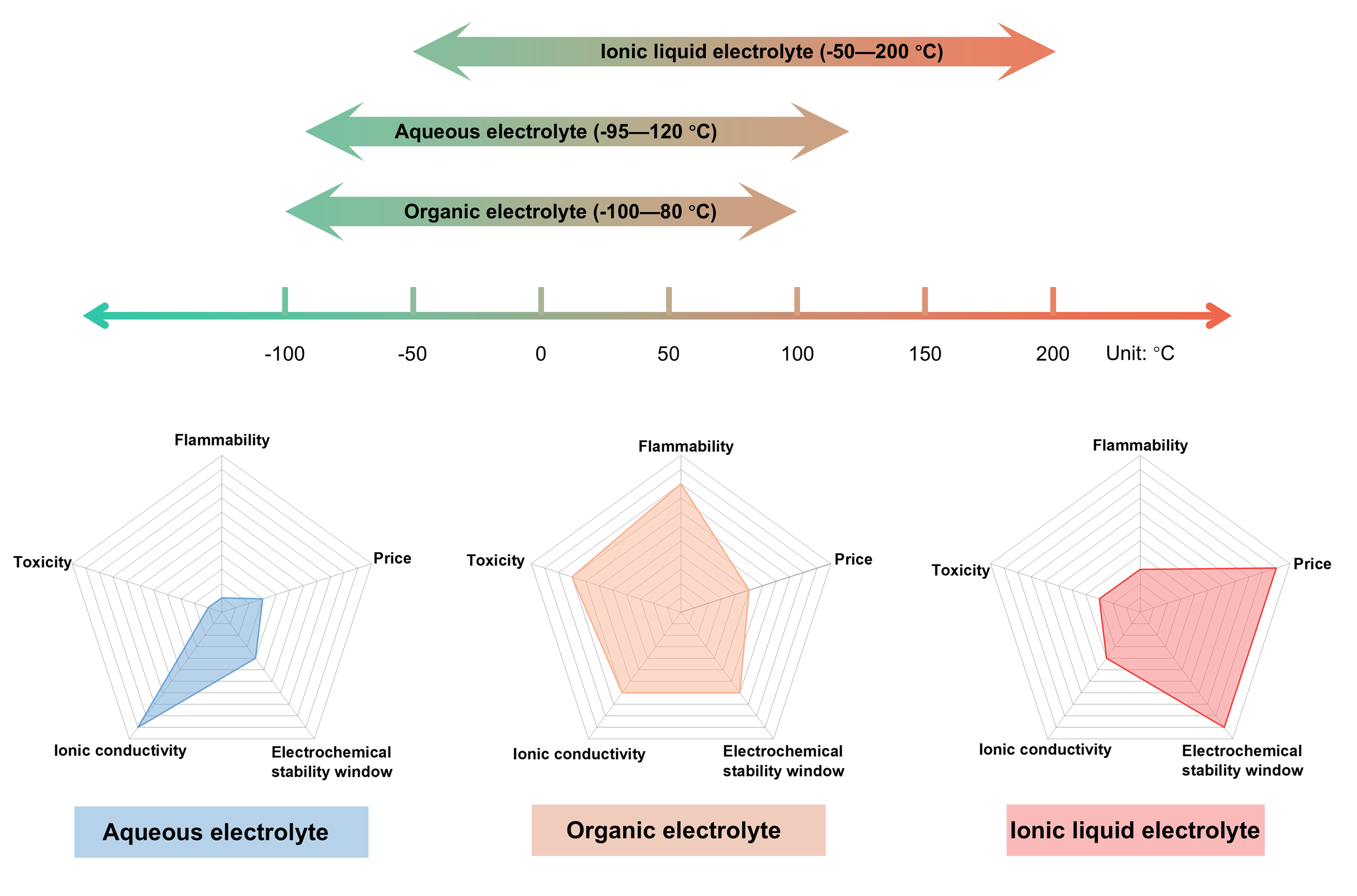
Electric double-layer capacitors (EDLCs), which store energy via reversible ion adsorption and desorption at the electrode-electrolyte interface, hold considerable promise for energy storage under extreme temperature conditions. However, their practical application faces significant limitations associated with temperature-dependent limitations: at high-temperature, electrolyte decomposition can reduce Coulombic efficiency or triggers device failure, whereas at low-temperature, diminished ionic conductivity or electrolyte crystallization leads to performance deterioration or functional breakdown. A comprehensive understanding of these constraints is therefore essential for designing EDLCs capable of operating reliably in extreme environments. This review begins with a systematic overview of the working principles and practical applications of EDLCs, followed by a comparative analysis of various electrolytes, highlighting their respective advantages and shortcomings. Subsequently, we outline specific design principles for both electrolytes and electrodes based on key physicochemical properties and summarize recent advances in high-temperature, low-temperature, and wide-temperature EDLCs. Finally, forward looking perspectives and strategic directions are proposed to guide the development of next-generation EDLCs capable of delivering stable performance under extreme temperatures. This review aims to provide critical insights and rational design guidelines to advance EDLC technology for demanding, extreme-environment applications.


