C.D. Ma, F. Zhou and Z.-S. Wu *
National Science Review, 2026, accepted.
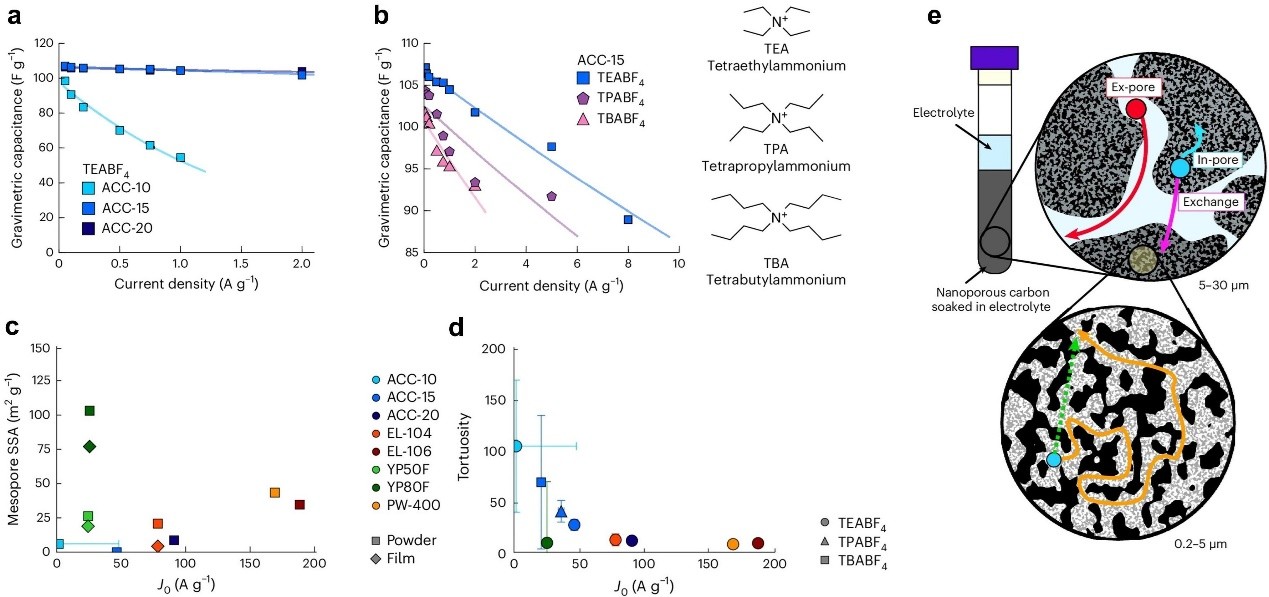
In summary, by integrating PFG NMR with electrochemical measurements, Kress et al. elucidate the fundamental factors governing fast-charging performance in nanoporous carbon-based supercapacitors. Their findings establish that pore network tortuosity and connectivity, rather than porosity alone, dictate ion transport kinetics and rate capability. This work advances a design paradigm shift: future electrode engineering should prioritize low-tortuosity, well-connected pore architectures to mitigate transport limitations, thereby enabling simultaneous enhancement of energy and power density. Beyond supercapacitors, these insights may also inform pore structure engineering in other electrochemical energy storage systems, such as batteries and hybrid capacitors, where efficient ion transport within porous electrodes is equally critical to high-rate performance.


