Recently, the team has made new progress in the controllable backup and micro-storage applications of two-dimensional transition metal borides (Boridene). The team developed an anhydrous lithium-ion solvent-assisted exfoliation strategy that converts layered molybdenum boride (MoB) derived from molybdenum-aluminum boron (MoAlB) into high-quality two-dimensional MoB nanosheets, and constructed high-performance miniature supercapacitors and flexible integrated microsystems.
Due to their unique electronic structure, high conductivity, and rich surface chemistry, two-dimensional transition metal borides have broad application prospects in the field of electrochemical energy storage. MoB can be obtained by selective etching to remove the aluminum (Al) layer from layered MoAlBs. However, this method often faces issues such as incomplete Al removal and interlayer re-stacking of MoB after etching, making it difficult to obtain fully stripped two-dimensional nanosheets. This reduces the usable surface area of the material, hindering electrolyte ions from entering interlayer active sites, thereby limiting the performance of MoB in high-rate energy storage devices.
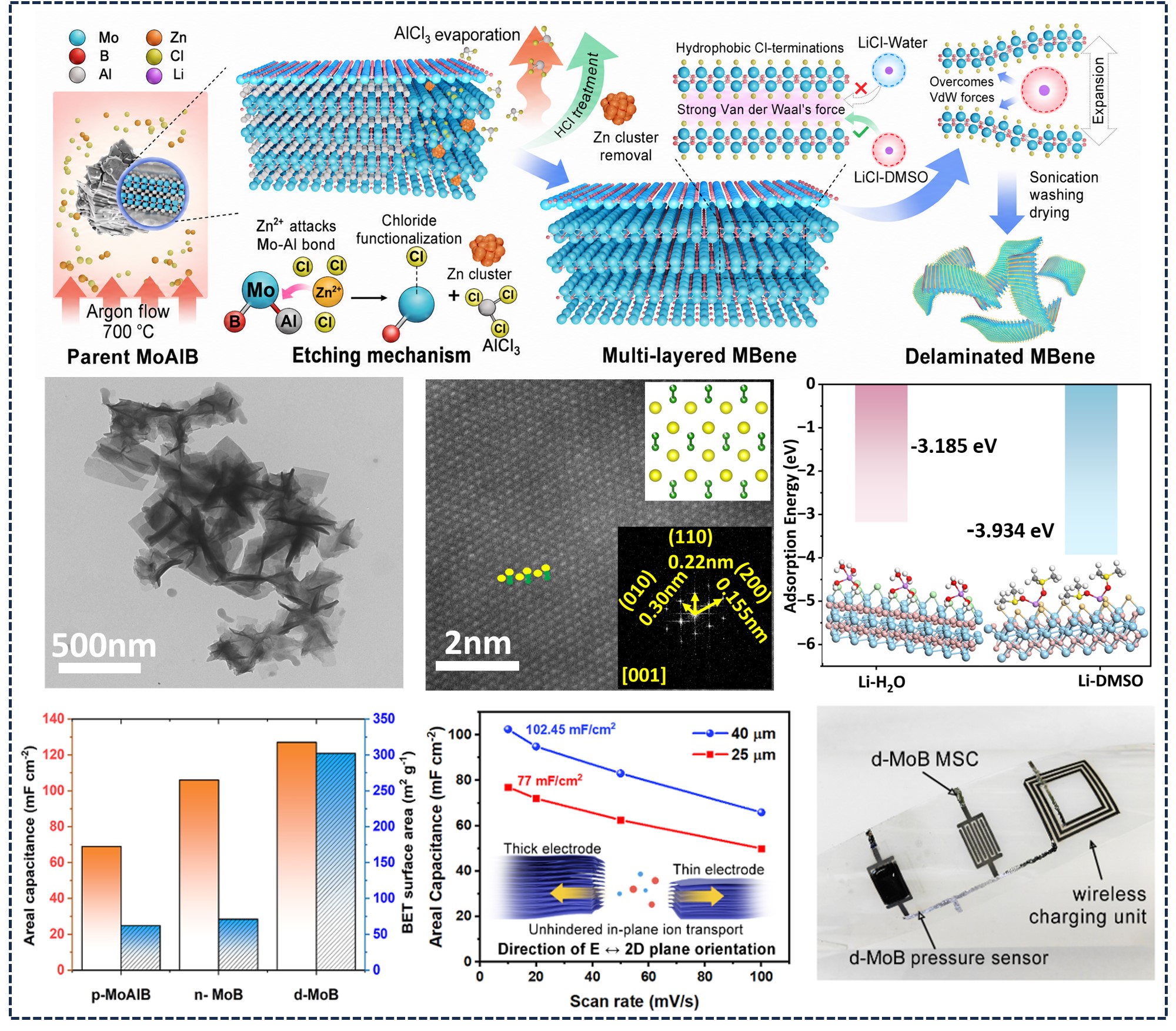
To address these issues, researchers first used zinc chloride (ZnCl2) molten salt etching to selectively remove the Al layer from MoAlB, obtaining layered MoB with Cl/O mixed surface end substrates; Subsequently, an anhydrous lithium chloride-dimethyl sulfoxide (LiCl–DMSO) intercalation strategy was introduced, using Li+–DMSO solvation complexes to expand interlayer spacing and combined with mild ultrasonic treatment, enabling the preparation of small-layer exfoliated MoB (d-MoB) nanosheets. The resulting MoB nanosheets have high phase purity and low surface oxidation, with an average thickness of about 3 nm and a transverse dimension of about 300 nm, increasing the effective contact surface area. By combining experimental characterization with theoretical calculations, researchers further clarified the mechanism of solvent-assisted intercalation: compared to hydrated Li+, the Li+–DMSO complex has a stronger ability to enter the MoB layer and promote structural expansion. Density functional theory calculations show that Li+–DMSO achieves good adsorption and produces electron-local effects on the MoB surface; Comparative intercalation experiments with different solvents also confirmed that the solvation and coordination environment of Li+ have significant effects on interlayer expansion and exfoliation efficiency.
Thanks to fewer layered structures, more exposed active surfaces, and shortened ion transport paths, d-MoB nanosheets exhibit enhanced electrochemical performance. The planar cross-finger miniature supercapacitor fabricated from this material has an area specific capacitance of 102.4 mF cm−2, an area energy density of 4 μWh cm−2, and can operate stably under conditions as low as −30 °C. In addition, the team integrated miniature supercapacitors with wireless charging coils and d-MoB base pressure sensors to build a flexible wireless charging–energy storage–sensing microsystem, demonstrating the application potential of d-MoB in miniature energy storage and flexible electronics.
The related research findings, titled "Solvent-Assisted Delamination of Boridene toward High-Performance Micro-Supercapacitors and Integrated Microsystems," were recently published in the Journal of the American Chemical Society Society). The co-first authors of this achievement are Group 508 PhD student Tasmia Azam, postdoctoral researcher Pratteek Das, and PhD student Ren Zhihao. The above work is supported by projects such as the National Natural Science Foundation of China, the Belt and Road International Scientific Organization Alliance (ANSO), and the Dalian Institute of Chemical Physics Innovation Fund.
Article Link: https://doi.org/10.1021/jacs.6c08895


