R.Z. Jiang, S.L. Sun, Y.P. Xie *, L.L. Yang, Z.C. Xu, S.S. Yuan, M. S. Sudi, X.P. Niu, M.Y. Cu, Z.-S. Wu, X. Yang and G.W. Xu *
SusMat, 2026, accepted.
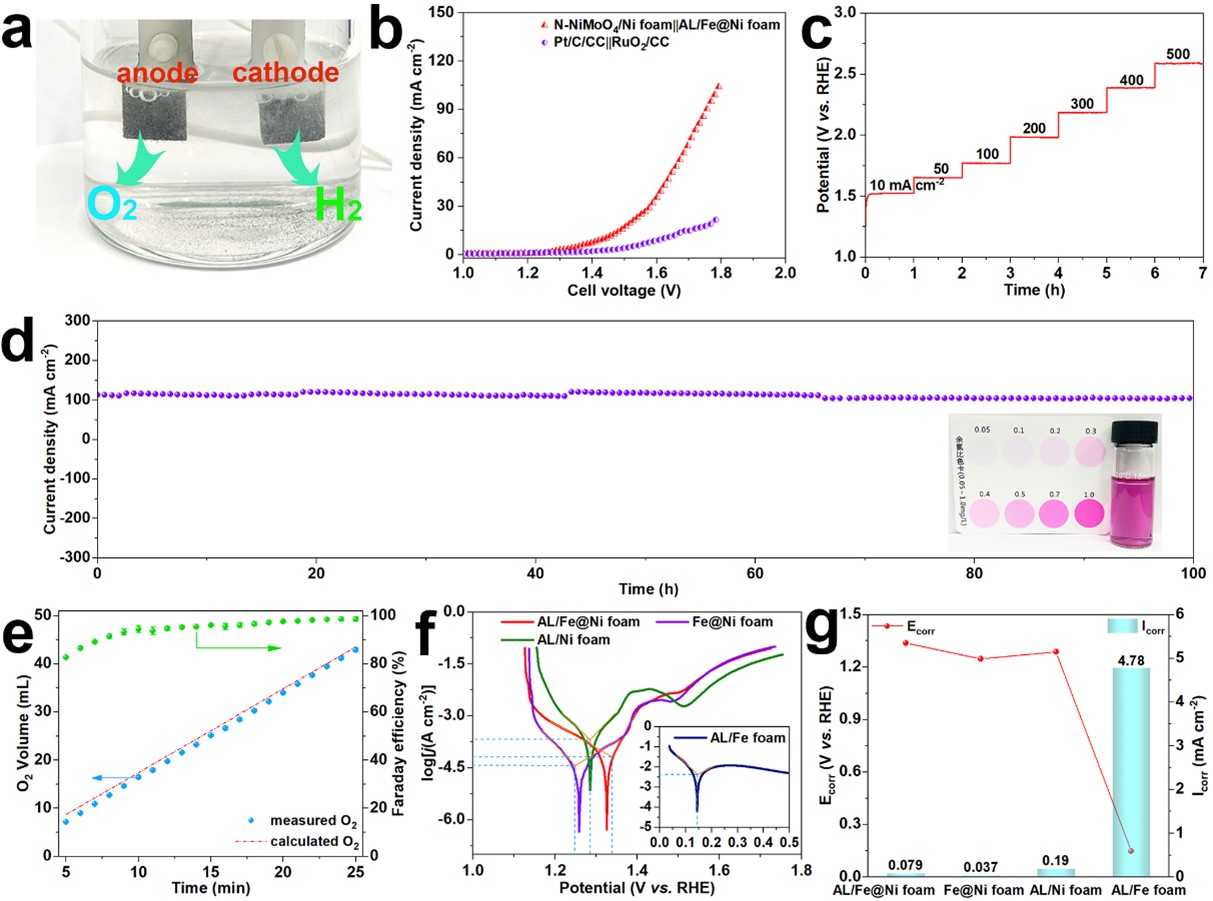
Direct seawater splitting powered by clean renewable energy has wide application prospect due to the environmental friendliness, resource abundance, and the utilization of renewable energy sources. However, it requires an efficient and robust anodic electrode to withstand chloride-induced corrosion and mitigate impurity interference. Here, we report amorphous FeNi-based hydroxides and phosphates layer on Fe@Ni foam (AL/Fe@Ni foam) via a facile in situ hydrothermal growth technique. The amorphous layer undergoes in situ reconstruction together with the dissolution of phosphate anions to form Fe doped Ni(oxy)hydroxide nanosheets during oxygen evolution reaction (OER), and Fe ions play an important role in promoting the reconstruction as confirmed by in situ Raman spectra, cyclic voltammetry curves (CV) and electrochemical impedance spectra (EIS). The high activity of the reconstructed phase, coupling with the enhanced mass transfer enabled by the superhydrophilic and superhydrophobic properties, results in exceptional electrocatalytic activity for alkaline seawater electrolysis. Above all, the excellent corrosion resistance of the electrode, and the high selectivity of OER due to the Cl2 evolution reaction suppressed by the phosphate anions adsorbed on the surface during the reconstruction process, synergistically contribute to the remarkable stability at high current densities. This work offers a new perspective for designing and fabricating highly efficient and robust electrode for seawater electrolysis.


